.jpg)
Yemen Offshore (Gulf of Aden)
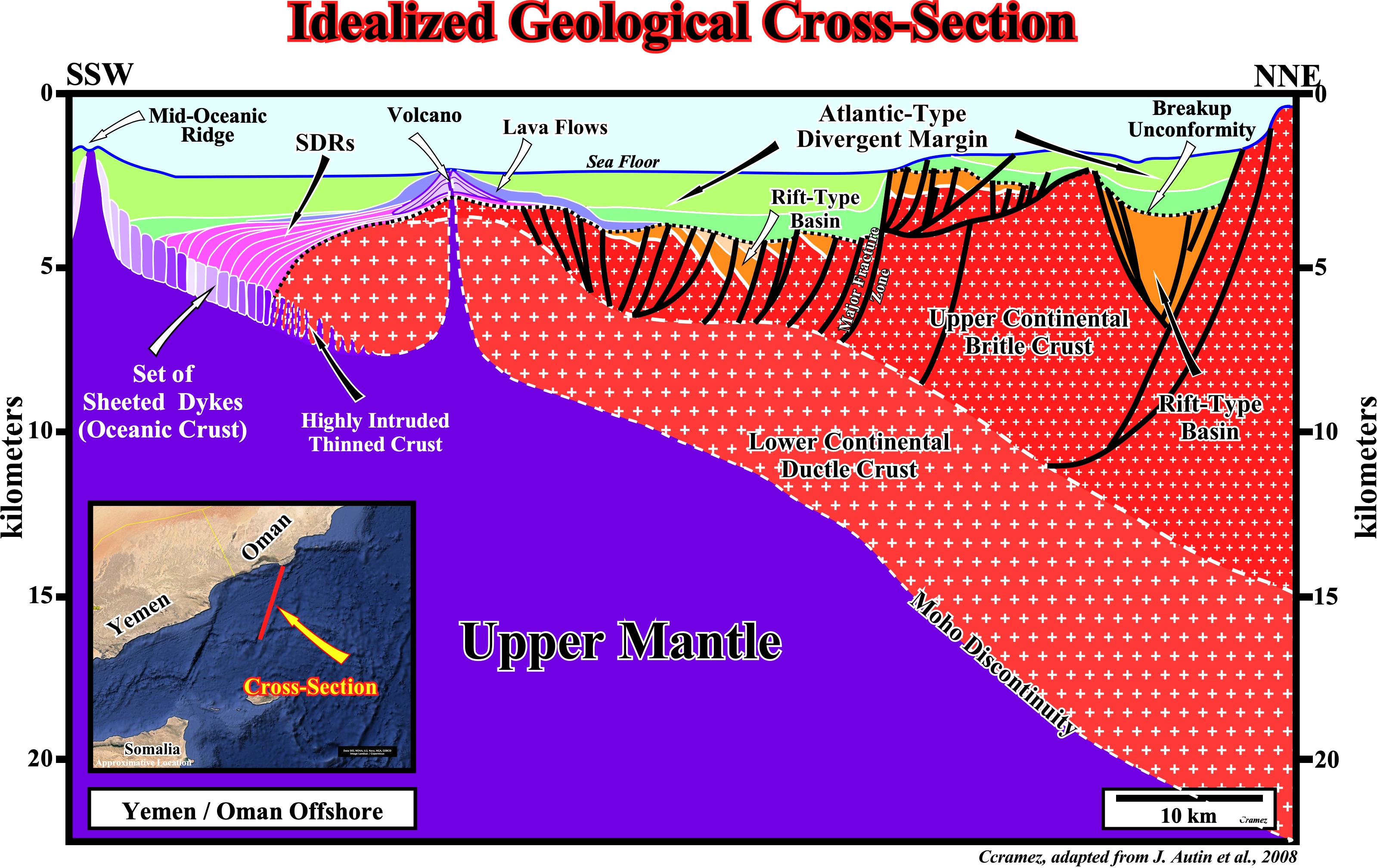
On this idealized geological cross-section of the southern Yemen / Oman offshore from the Mid-Oceanic Ridge to the onshore we can recognize: (i) The oceanic crust, probably, represented by pillow lava coming out of submerged complex of sheeted dykes overlying the lower part of the crust composed by ultramafic rocks ; (ii) The SDRs, i.e., sub-aerial lava flows emerging from outcropping sheeted dykes formed just after the breakup of the Gondwana lithosphere; (iii) Thinned and highly intruded Lower Continental Crust (when the mantle's intruded material becomes predominant there separation and creation of two continents) ; (iv) A Volcano, i.e.,a fissure in the Earth's surface through which molten lava and gases erupted forming an outward complex of lava flows ; (v) The lengthened Upper Continental Crust with the associated Rift-Type Basins, which are, generally, are filled by non-marine sediment, since they predate the breakup of the Gondwana lithosphere and (vi) The Breakup Unconformity, which emphasize the breakdown of the Gondwana, mainly, by the changing of a differential subsidence to a thermal subsidence, which is, mainly, responsible for the sediment accommodation's magnitude during the margin deposition (eustasy , i.e., the absolute sea level's changes are, primarily, responsible for the cyclicity of space available for the sediments (accommodation). On the Yemen sector of this offshore, over the SDRs, a salt layer was deposited as illustrated on the next Canvas autotrace.
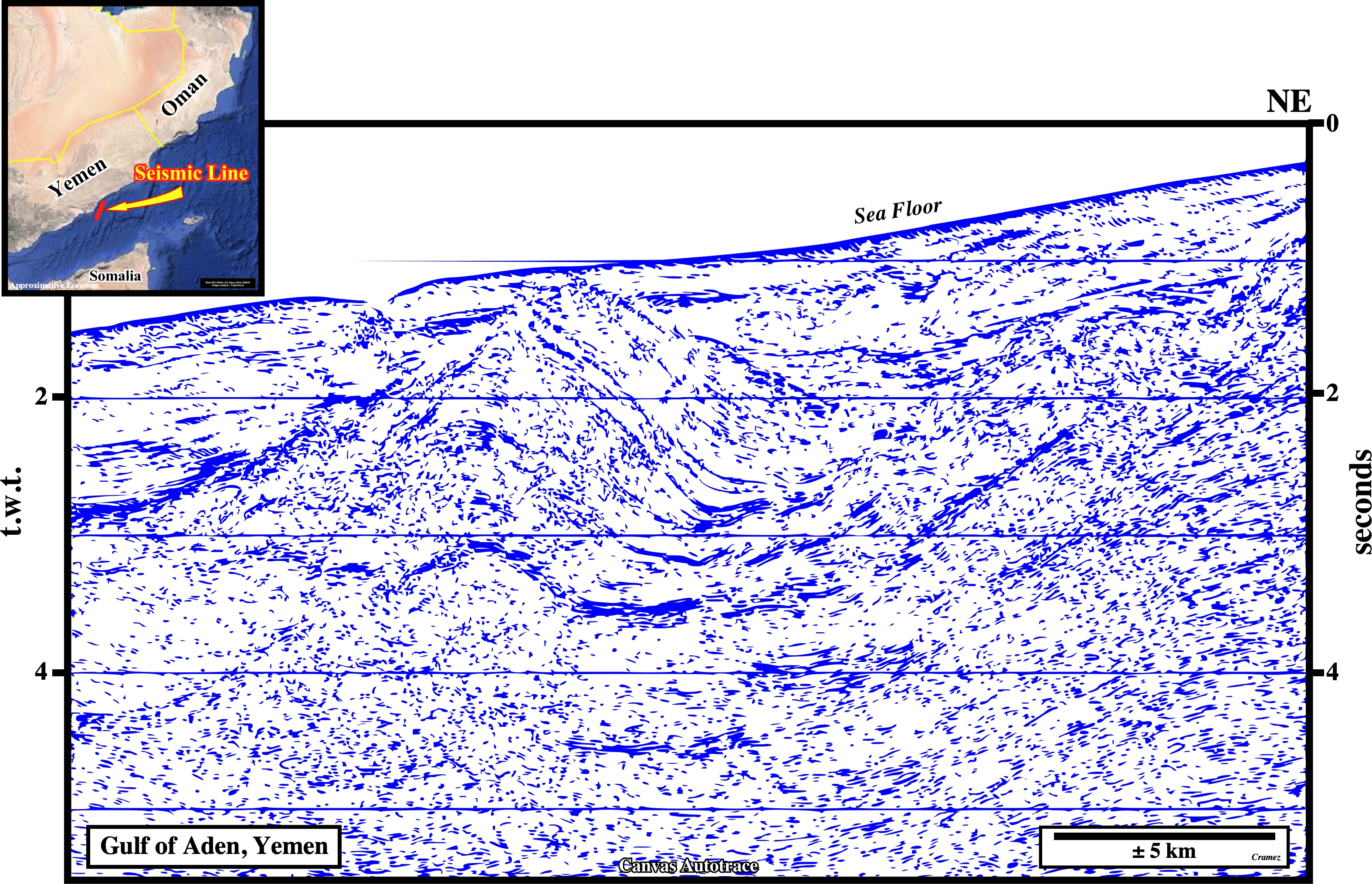
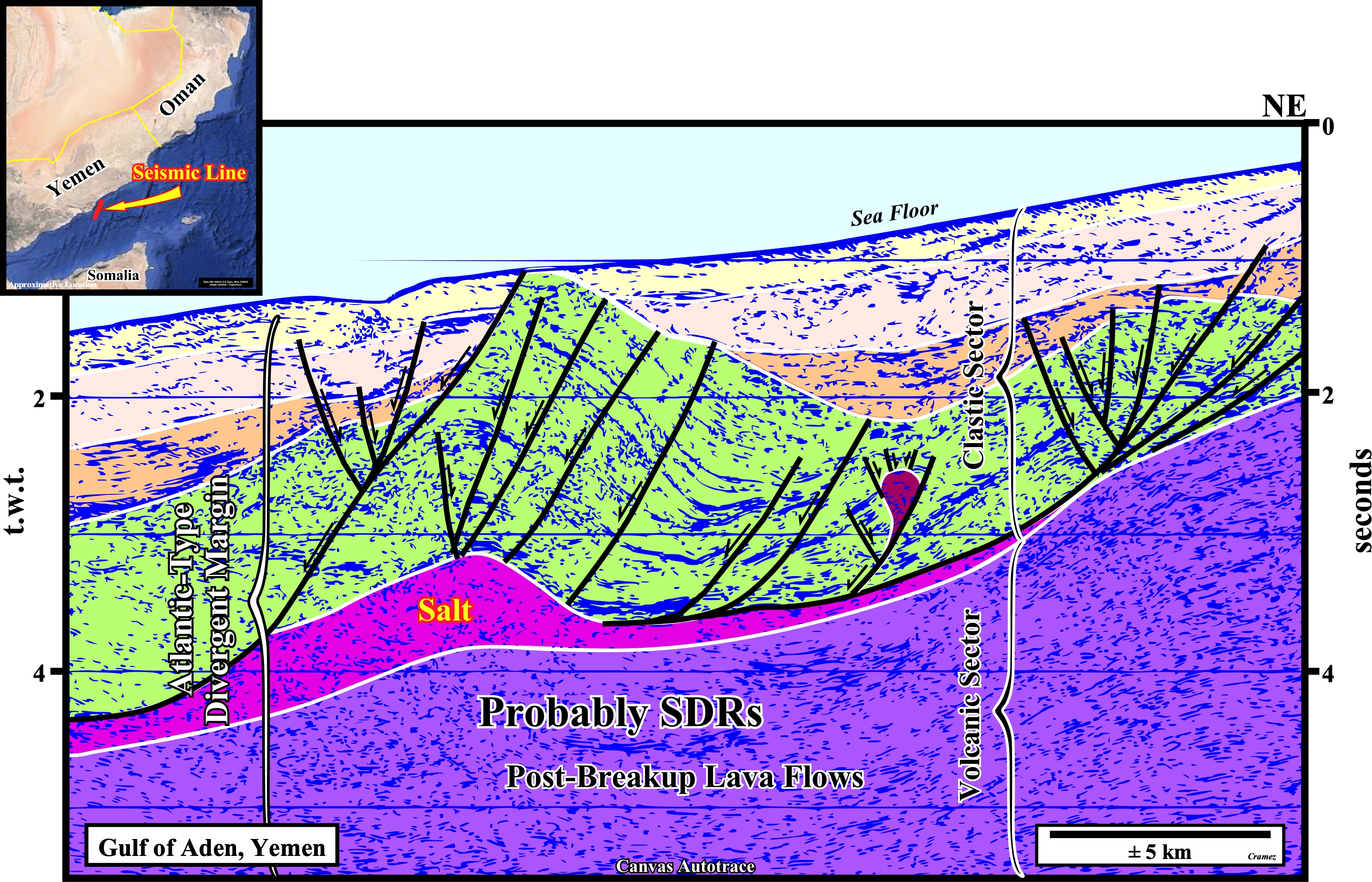
On this tentative interpretation of a Canvas autotrace of a seismic line of the Southern Yemen offshore where the dipping seaward seismic reflectors, in the lower eastern part of the line, can be interpreted as sub aerial lava flows, that is to say, sub-aerial lava-flows emplacement after the breakup of the lithosphere, the presence of an evaporitic interval is quite evident. It creates a sharp tectonic disharmony at the base of the evaporitic layer, i.e., between the post breakup lava-flows (SDRs) and the cover (evaporites + overburden). In other words, above the tectonic disharmony, the cover is, strongly, deformed (lengthened), mainly, by halokinesis (form of salt tectonics, in which the flowage of the salt is powered by buoyancy, i.e., by release of gravity potential energy alone, in absence of significant lateral tectonic forces), while the the SDRs are not. In fact the SDRs are just tilted seaward due to the weight of stacked lava-flows. The antiform structure, recognized in the central part of this Canvas autotrace, was induced by lateral flowage of the evaporite interval deposited in the lower part of the Atlantic-type divergent margin (if there are infra-salt margin sediments their thickness seems to be under seismic resolution). The salt composition, quite rich in potash, favor the hypothesis that the salt layer was deposited above basaltic material, eventually SDRs, which, strongly, enrich the brine in heavy mineral and potash (spilitization of basaltic material, probably SDRs, by oceanic water).


Send E-mails to carlos.cramez@bluewin.ch with comments and suggestions to improve this atlas.
Copyright © 2001 CCramez
Last update:
2022