.jpg)
Kenya Offshore
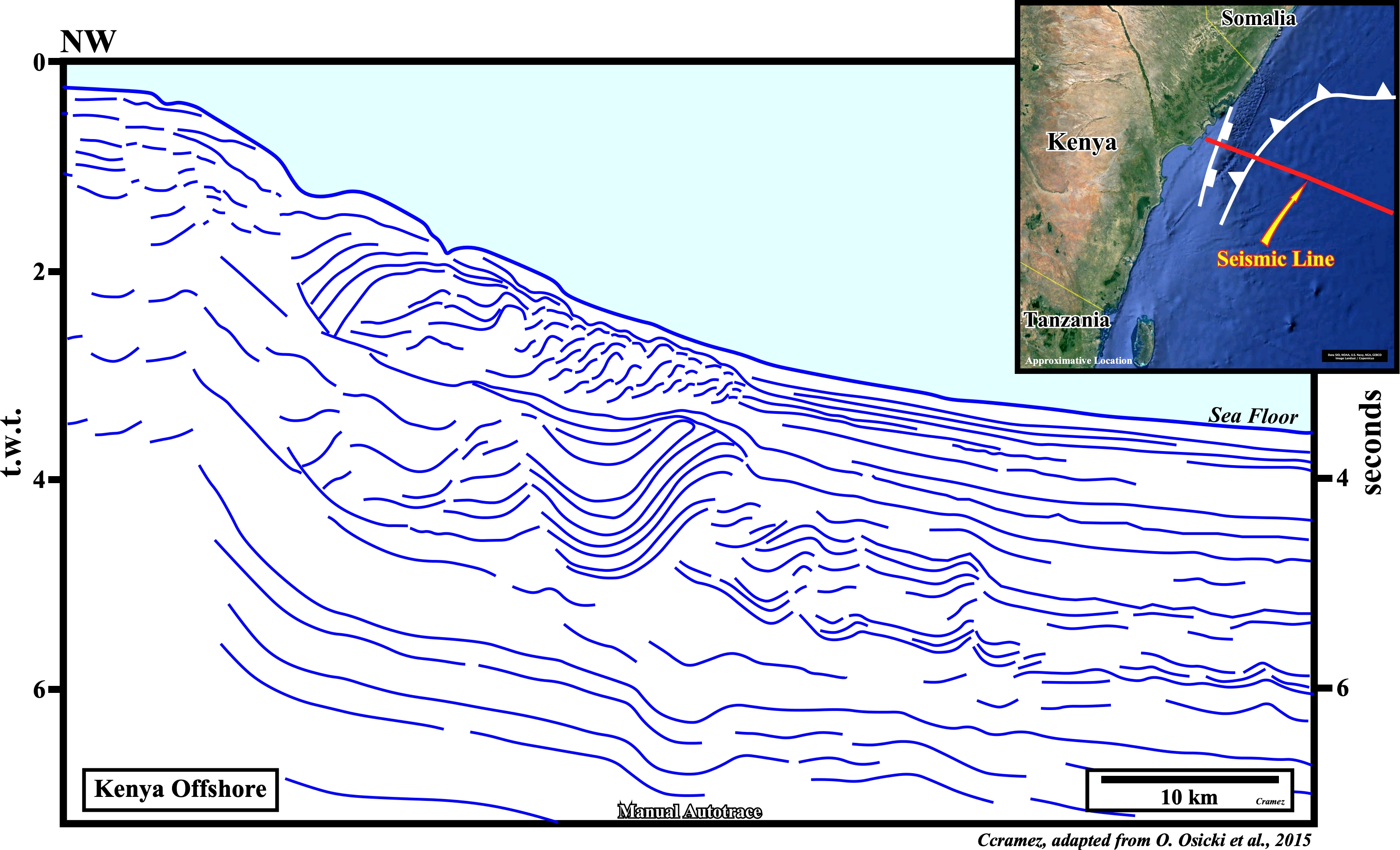
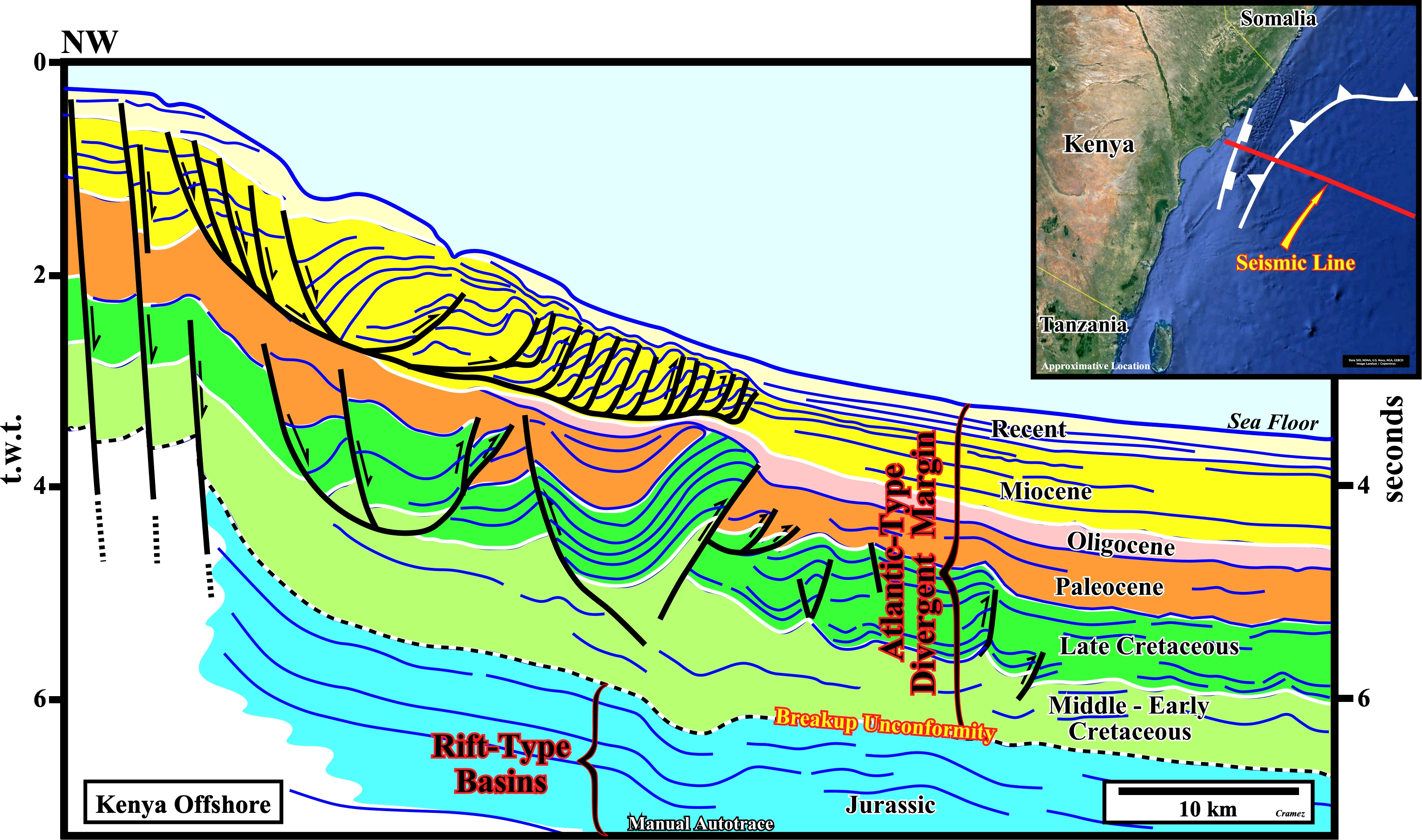
On this manual autotrace of a dip seismic line of the northern Kenya offshore perpendicular to the seismic line illustrated on Page 45 (manual autotrace), two gravitary folded-belt are obvious in the Atlantic-type divergent margin bounded by between the breakup unconformity and the sea floor. The seismic line of this autotrace is, roughly, parallel to the σ2 (medium axis) of the effective stresses ellipsoid characterizing the extensional tectonic regime during which the rift-type basins were formed and infilling. In other words, the seismic line being, more or less, parallel to the normal faults bordering the rift-type basins predating the breakdown of the Gondwana small supercontinent, the half-grabens are just, clearly, visible on perpendicular lines, see Page 45. The gravitary folded-belts visible on this autotrace are nothing more that huge curvilinear faults in which the distal shortening is the counterpart of the up-dip to sedimentary lengthening, that is to say, huge listric faults, which were defined as particular curvilinear faults having a normal fault geometry up-dip and a reverse fault geometry down-dip, as the movement in a slumping fault (listric comes from "listron" that in Greek, means "spoon"). In spite of the fact etymologically all listric faults are curvilinear but not all curvilinear faults are listric, presently, the term listric is used to express all kinds of fault having a curvilinear geometry.


Send E-mails to carlos.cramez@bluewin.ch with comments and suggestions to improve this atlas.
Copyright © 2001 CCramez
Last update:
2022