.jpg)
South Africa Offshore
Natal Valley Geographic Basin
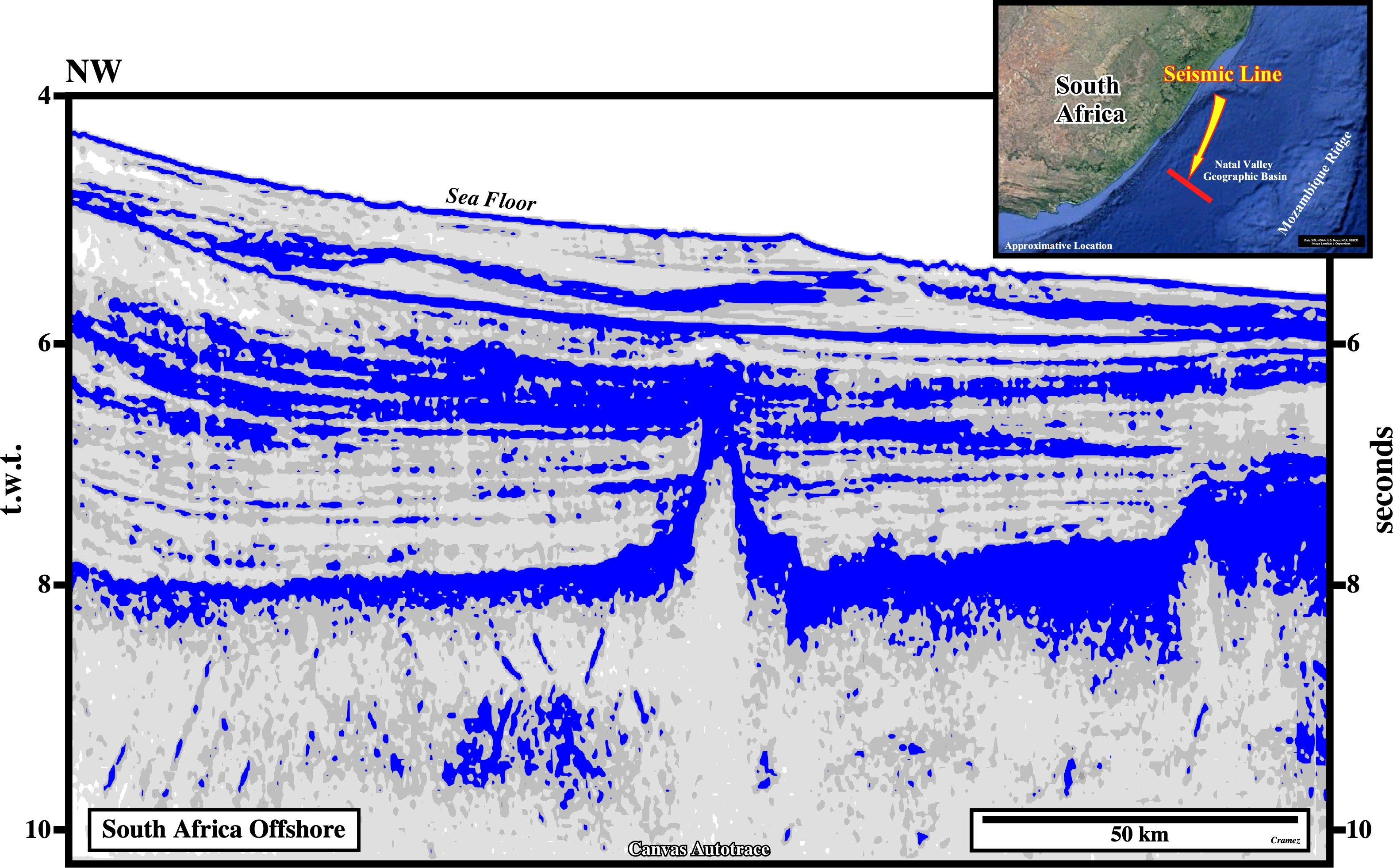
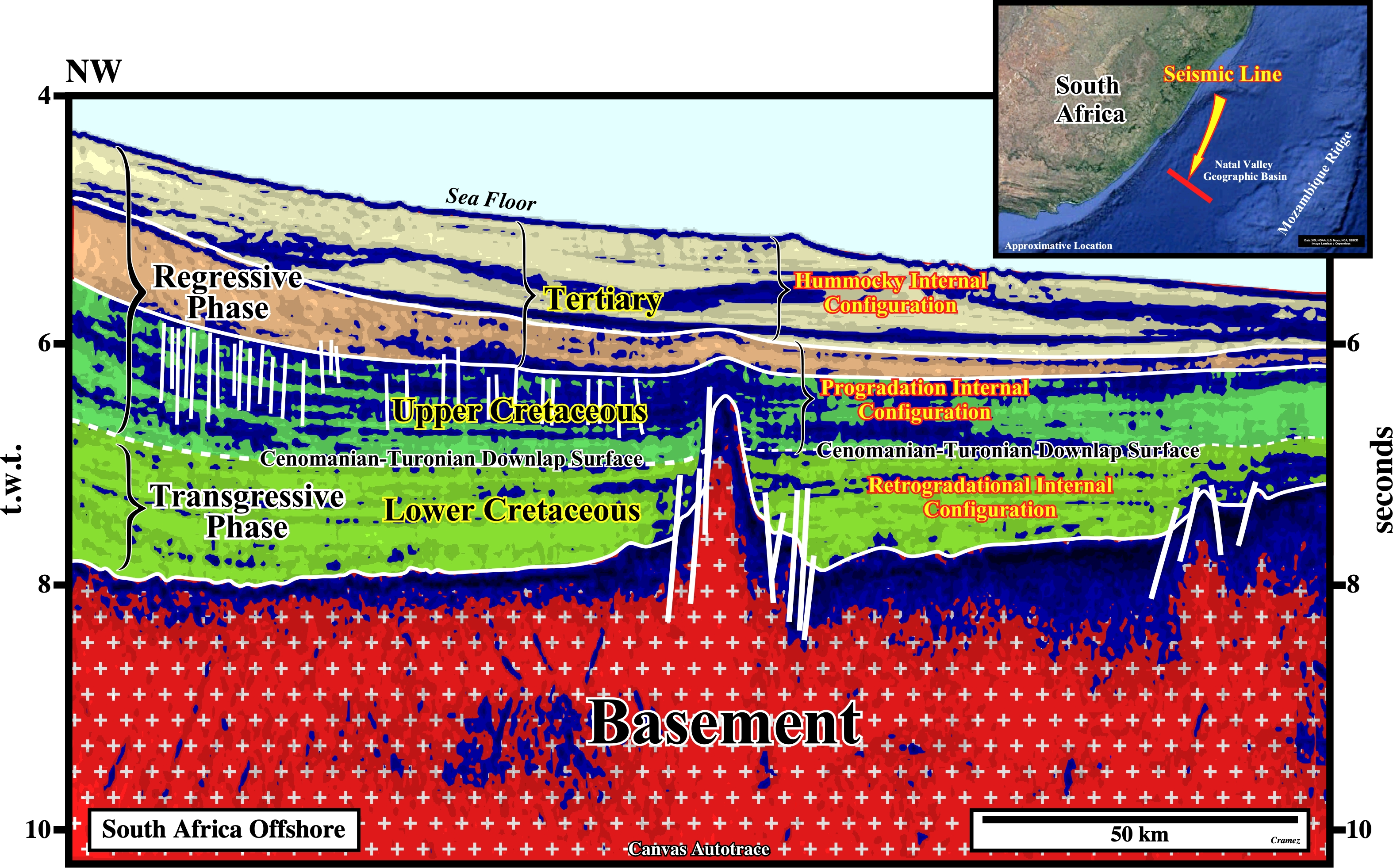
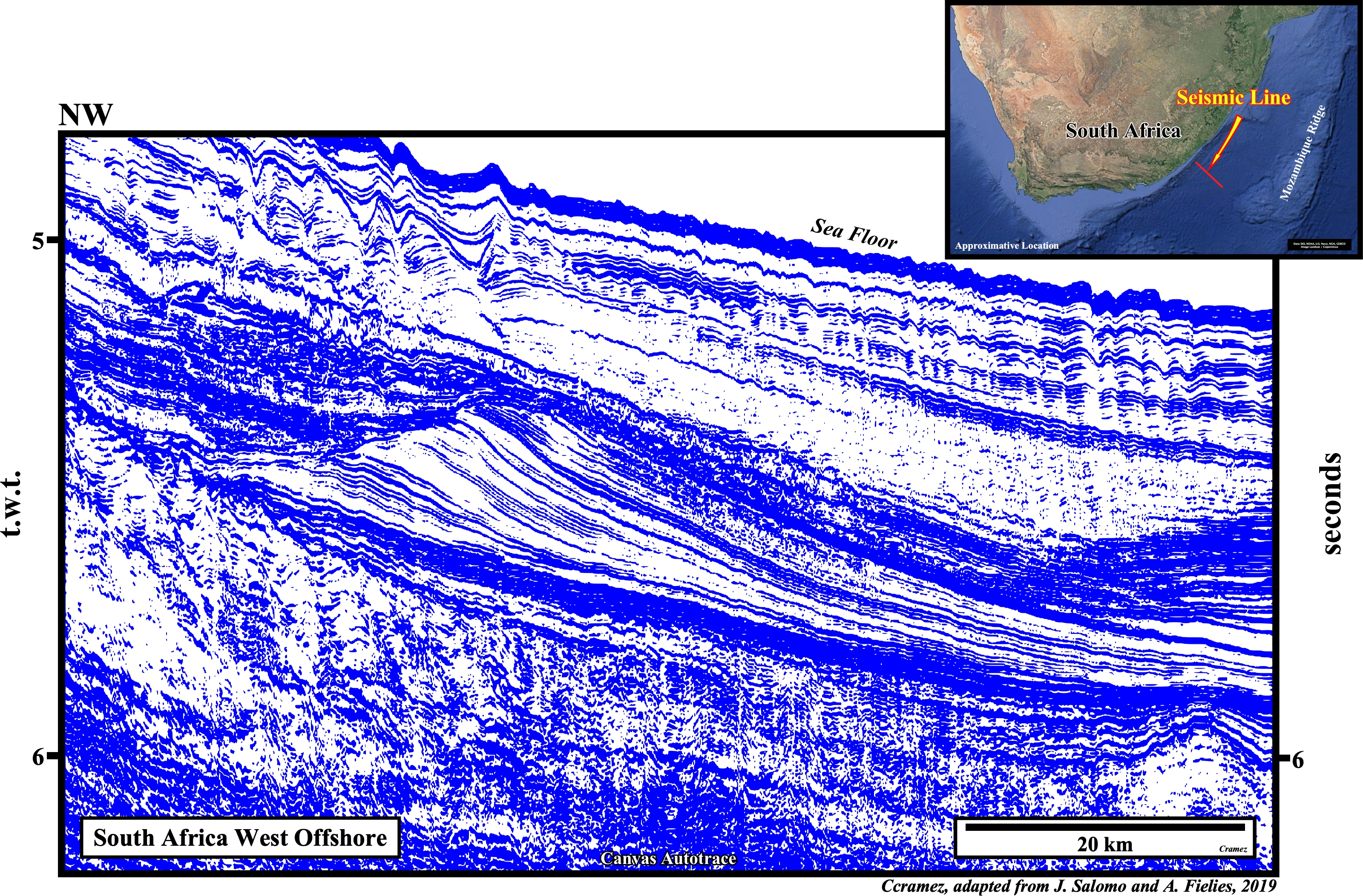
On the tentative geological interpretation of a Canvas autotrace of a regional seismic line of the Natal Valley geographic basin, the post-Pangea continental encroachment stratigraphic cycle is well represented. The Cenomanian-Turonian downlap surface differentiating the transgressive stratigraphic phase from the regressive phase is also recognized, easily, taking into account the internal configuration of these phases. An aggradational geometry (backstepping) for the transgressive phase and progradational geometry (forestepping) for the regressive phase. The probability of finding a generating petroleum sub-systems (source-rocks) in association with the Cenomanian-Turonian downlap surface is quite small, taking into account that the water depth does not play any role in the maturation of the eventual organic matter deposited and preserved in the stratigraphic condensed sections related with a downlap surface. On the other hand, there is, also, an almost total evidence of a potential entrapment-migration petroleum sub-systems (trapping), except on the uppermost Tertiary interval where morphological traps by juxtaposition are possible in association with along slope elongated contourites, as illustrated on the next plates.
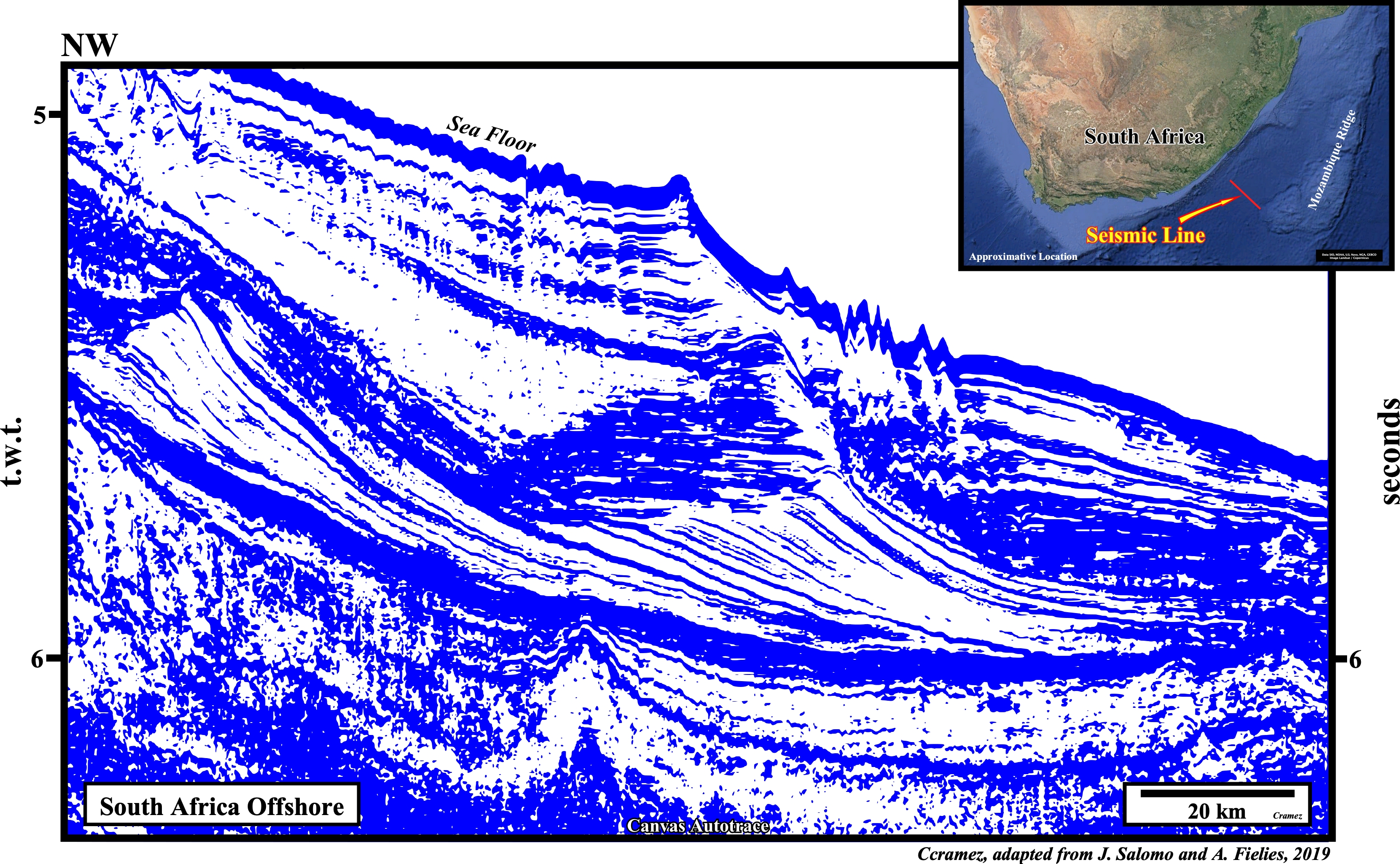
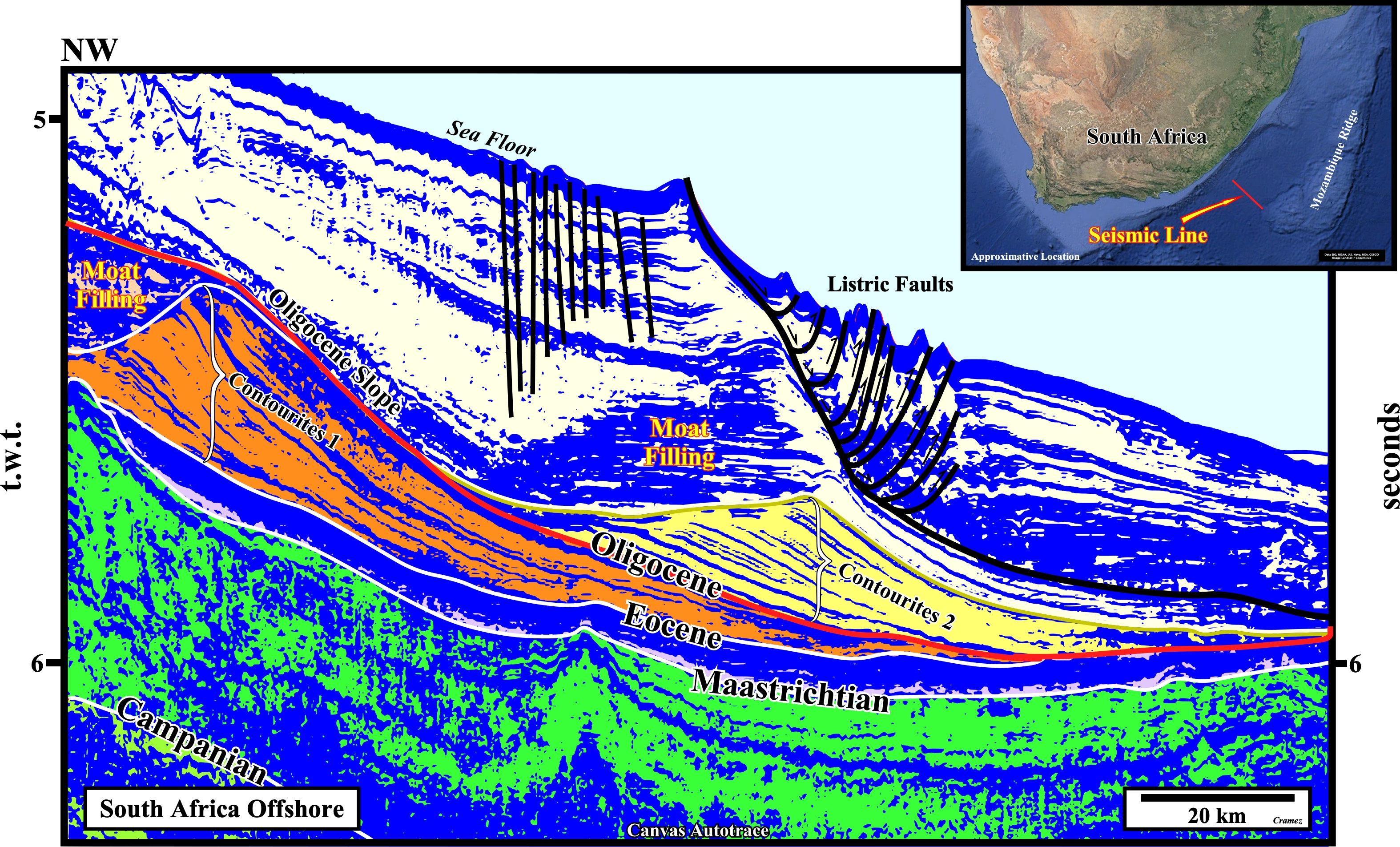
On this Canvas autotrace there is evidence of an Oligocene contourite (contourite 1) overlapped by a Miocene contourite (contorite 2). The progradational internal configuration of the contourites, strongly, suggests a local downslope terrigeneous influx associated with along slope deep marine currents (contour currents). The moats, which underline the path of the contour currents, are filled by aggradational sediments showing onlap terminations. These contourites should not be taken as the "Gull-Wings structures" of P. Vail formed in submarine slope fans (turbidites) as illustrated in next plate.

Knowing the geological model proposed by several geoscientists ("Theory precedes Observation" K. Popper, 1934) and, particularly, the Rebesco model (Rebesco, M. et al., 2014) illustrated on the lower corner of this plate, advanced to explain the geometry of the genesis of the contourites, it is quite easy to recognize them on Canvas autotraces. Their asymmetry, as well as their large size differentiate them from channel-levee systems ("Gull Wings") generated by turbidite currents (gravitational currents). It is interesting to remind the base of the moat infilling does not correspond to an sharp erosional feature and even less to an unconformity (sea level fall), but rather to a bypassing area (area without deposition) of the currents. In fact, the sediments deposited or substantially reworked by the action of bottom currents (mainly thermohaline- and wind-driven) that have an overall along-slope flow (though extremely variable in both time and space). Note the development of contourite depositional system includes an erosion to charge the currents and later (not at same place) depositional features (sediment drifts). In other words, at the time of deposition the moat is not, generally, an erosional feature but just a simple depression created by the lateral stacking of the successive contourite layers.


Send E-mails to carlos.cramez@bluewin.ch with comments and suggestions to improve this atlas.
Copyright © 2001 CCramez
Last update:
2022