.jpg)
Libya Offshore
Cyrenaica Offshore
Libya Offshore
Cyrenaica Offshore
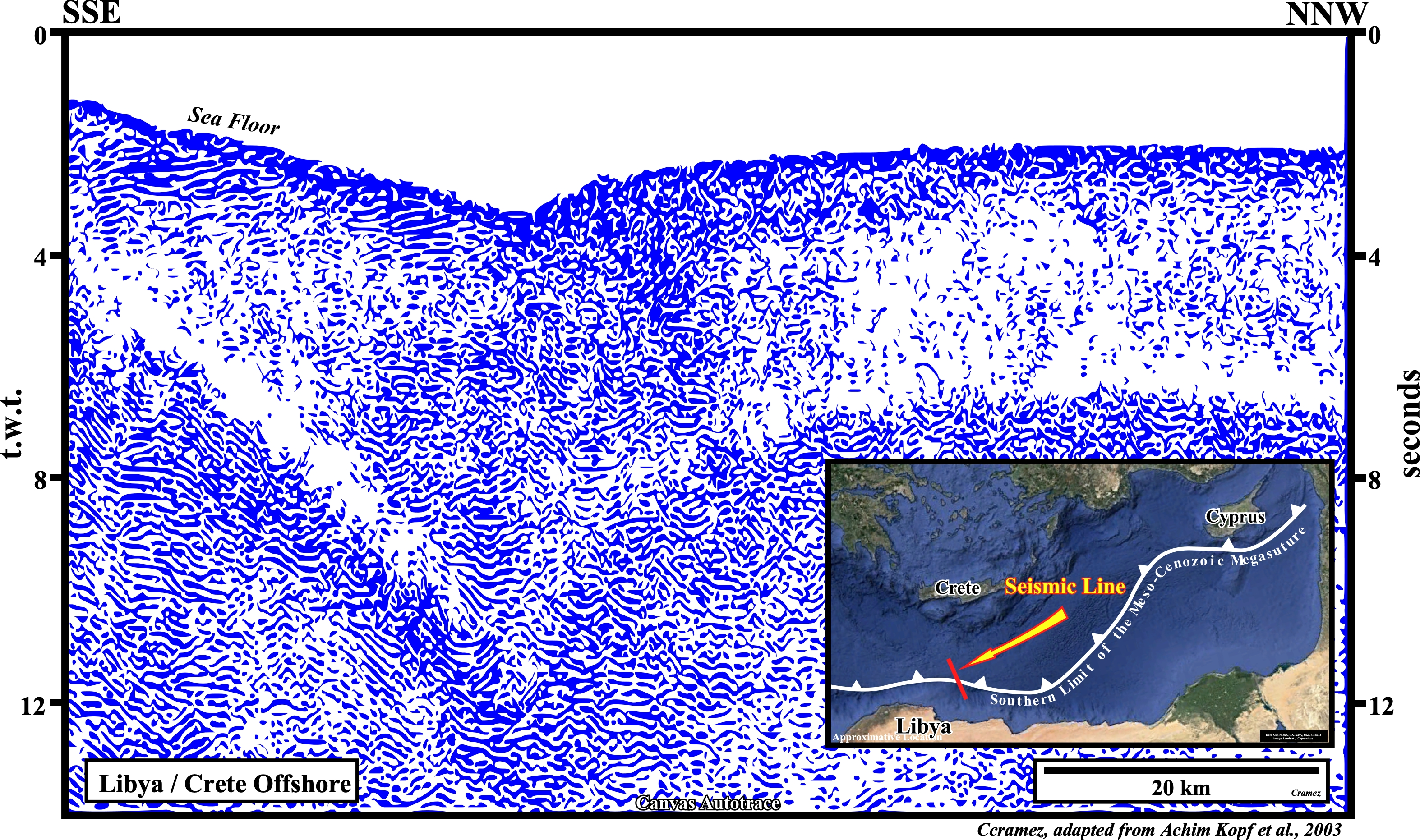
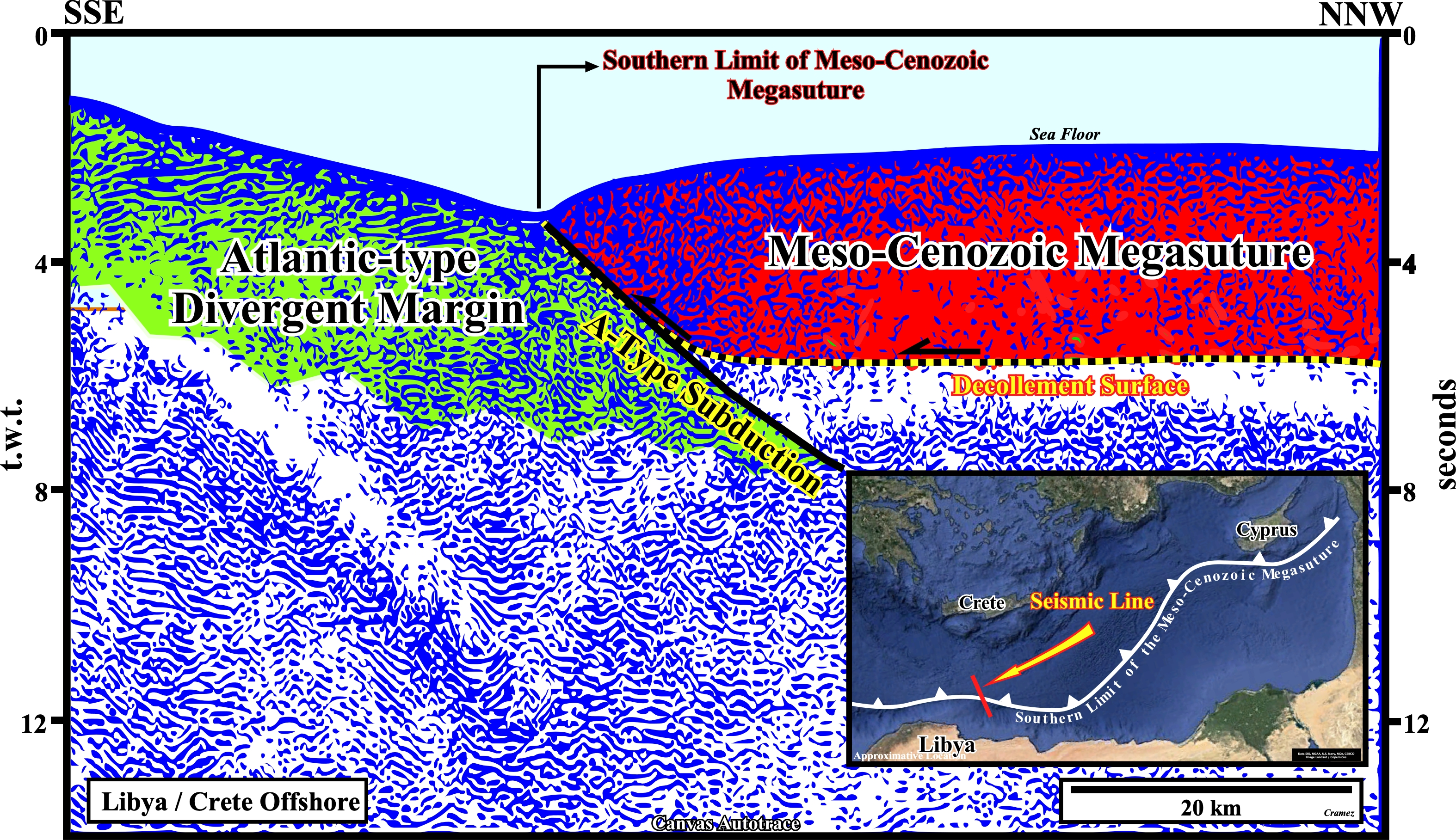
On this tentative geological interpretation of a Canvas autotrace of a Libyan offshore seismic line we assume the lower bathymetric anomaly underlines the southern boundary of the Meso-Cenozoic megasuture, as well as, a decollement surface of the associated accretionary complex. In fact, it is quite plausible that such a boundary corresponds to a A-type subduction zone (Ampferer subduction), which we remember is the plunging of a continental lithospheric plate (sialic composition) under another plate forming a megasuture. In depth, it appears the subducting lithospheric plate can be, partly, consumed. On the other hand, due to the compressional tectonic regime (σ1 horizontal), created by the subduction zone, the sediments of the overriding lithospheric plate are shortened by folds, thrusts and strike slip faults with the formation of an accretionary wedge between the two plates (Mediterranean Ridge, which is a more than 300 km wide and ± 2000 km long). Notice that parts of the eastern Mediterranean Sea represent remnants of Tethyan oceanic seafloor which have been preserved despite Alpine orogeny (collision of the Africa-Arabian Plate with Eurasia). This seafloor is, presently, plunging along the Hellenic subduction, south of mainland Greece, and the island of Crete, while the volcanic arc is represented by small islands (e.g., Santorini) in the southern Aegean Sea.


Send E-mails to carlos.cramez@bluewin.ch with comments and suggestions to improve this atlas.
Copyright © 2001 CCramez
Last update:
2022