
Gulf of Mexico
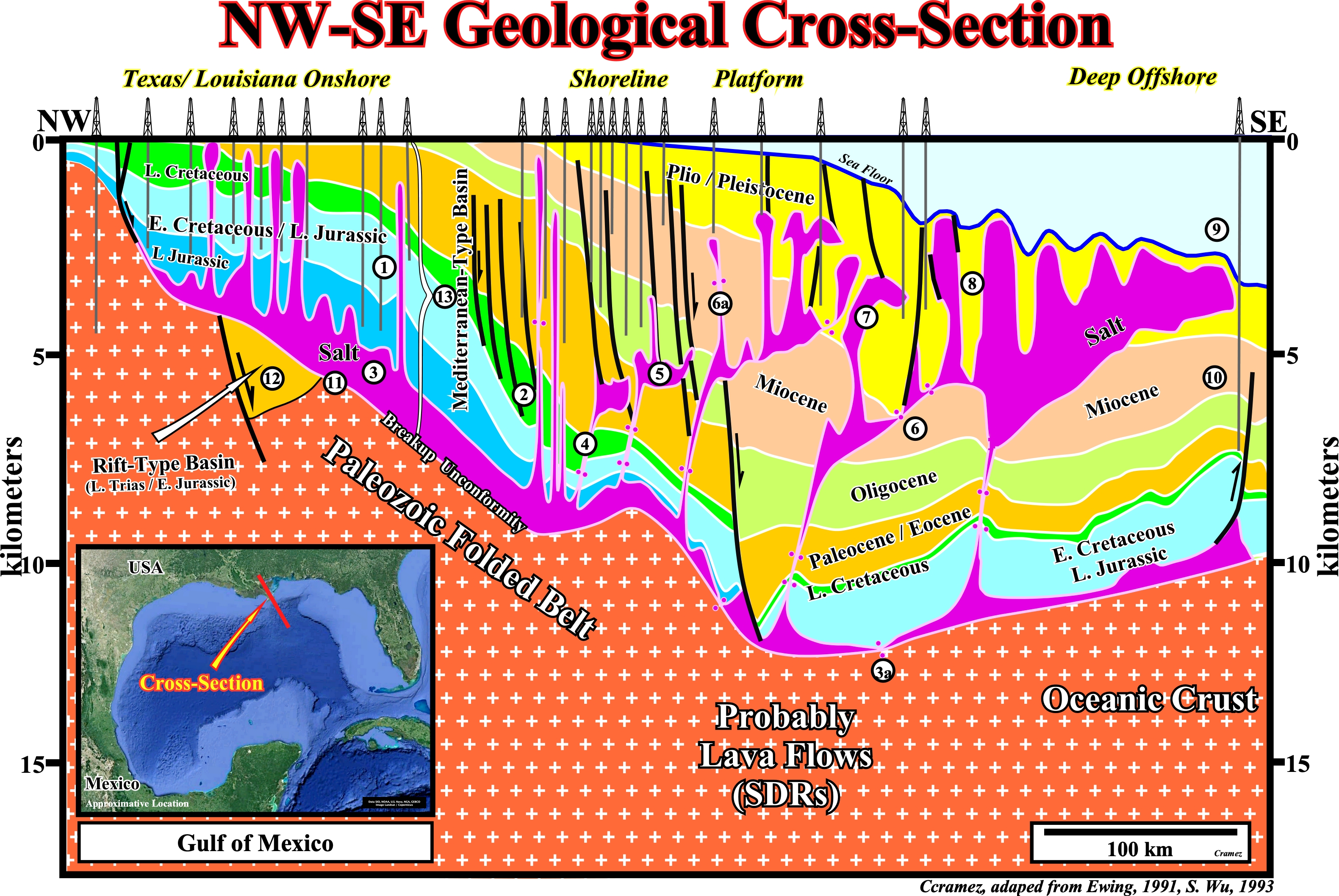
On this geological cross-section of the Gulf of Mexico, which correspond to the offshore of a Meso-Cenozoic Mediterranean-type basin, the substratum is a lengthened Paleozoic folded belt, on which rift-type basins developed before its breakdown, that is to say, before the oceanization. The numbers on the cross-section highlight: (i) Limit Platform-Slope at Middle Cretaceous time ; (2) Organic rich interval, which contains potential source rocks ; (3) Allochthonous Salt ; (3a) Primary Salt Weld ; (4) Secondary Salt Weld or Salt Ramp ; (5) 1st Allochthonous Salt Generation ; (6) Tertiary Salt Weld, i.e., a salt weld associated with a 1st order allochthonous salt ; (6a) Vertical Salt Weld associated with a 1st order allochthonous salt ; (7) 2sd Allochthonous Salt Generation ; (8) Expulsion Basin (mini-basin) on a Salt Nappe ; (9) Sigsbee Escarpment ; (10) Perdido Fold Belt ; (11) Breakup Unconformity between the lengthened Pangea continental crust and the overlying Mediterranean-Type Basin ; (12) Mesozoic Rift-Type Basin and (13) Meso-Cenozoic Mediterranean-Type Basin.
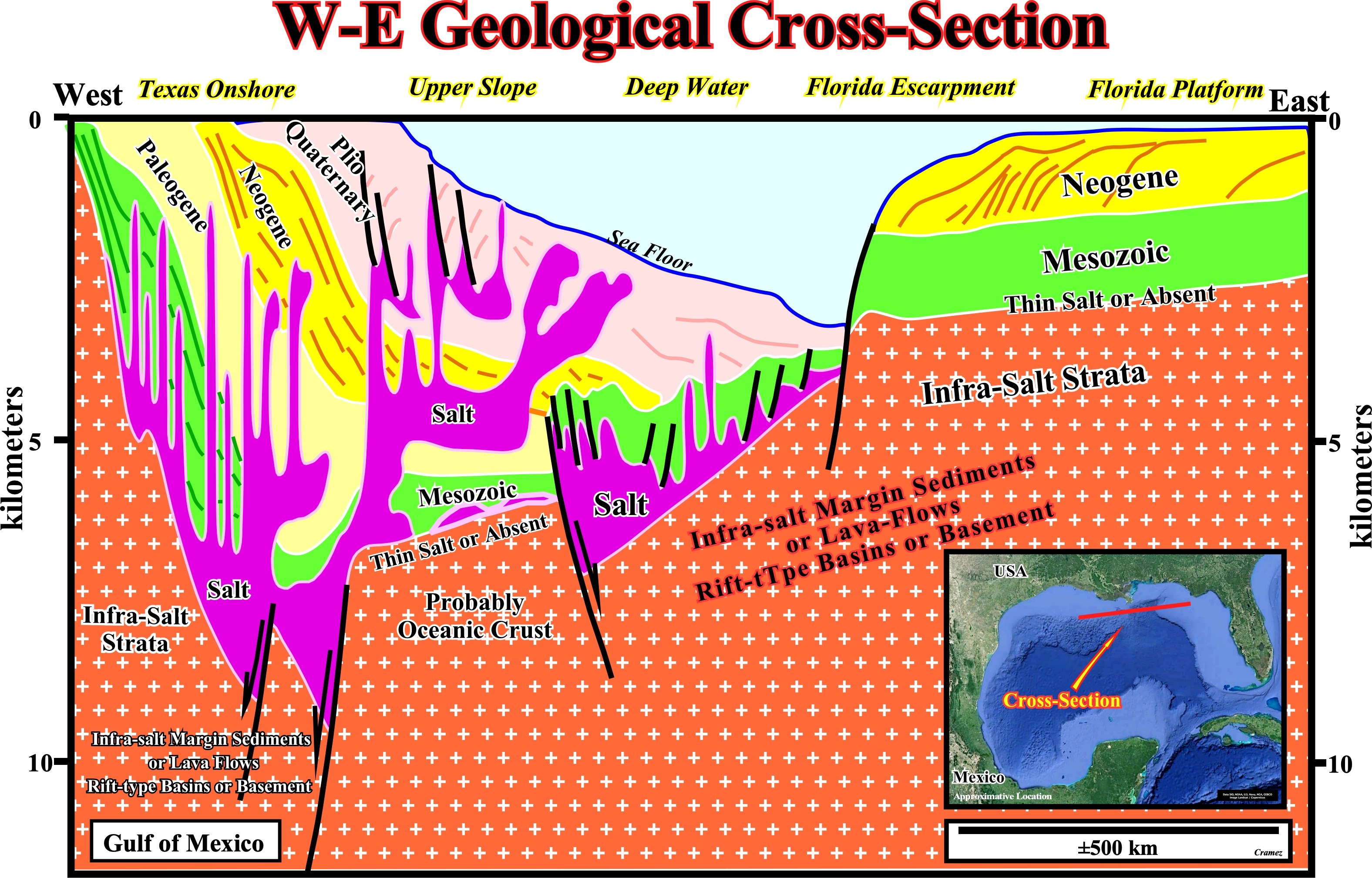
On this geological cross-section, firstly, it must be notice that the infra-salt strata can represent : (i) The Pangea continental crust, in which Mesozoic rift-type basins, formed during the lengthening of the crust, can be developed ; (ii) Post breakup lava-flows, i.e., seaward dipping reflectors (SDRs) that represent the sub-aerial volcanic section of the non-Atlantic type margin of the Mediterranean-type basin ; (iii) Infra-salt margin sediments, which are, generally, quite thin (often under the seismic resolution), and form the base of the clastic margin section over which the autochthonous salt layer is deposited ; (iv) Oceanic crust, since the expansion center are immersed ; (v) Paleozoic folded belt or a Precambrian basement. Secondly, do not forget, this cross-section was buildup just to illustrate the allochthony of the salt layer. Thirdly, majority of the salt welds were omitted, particularly the second and third order. In fact, a lot of allochthonous salt bodies are, completely, disconnected of the mother salt rock or from the salt nappes, as illustrated on next autotrace.
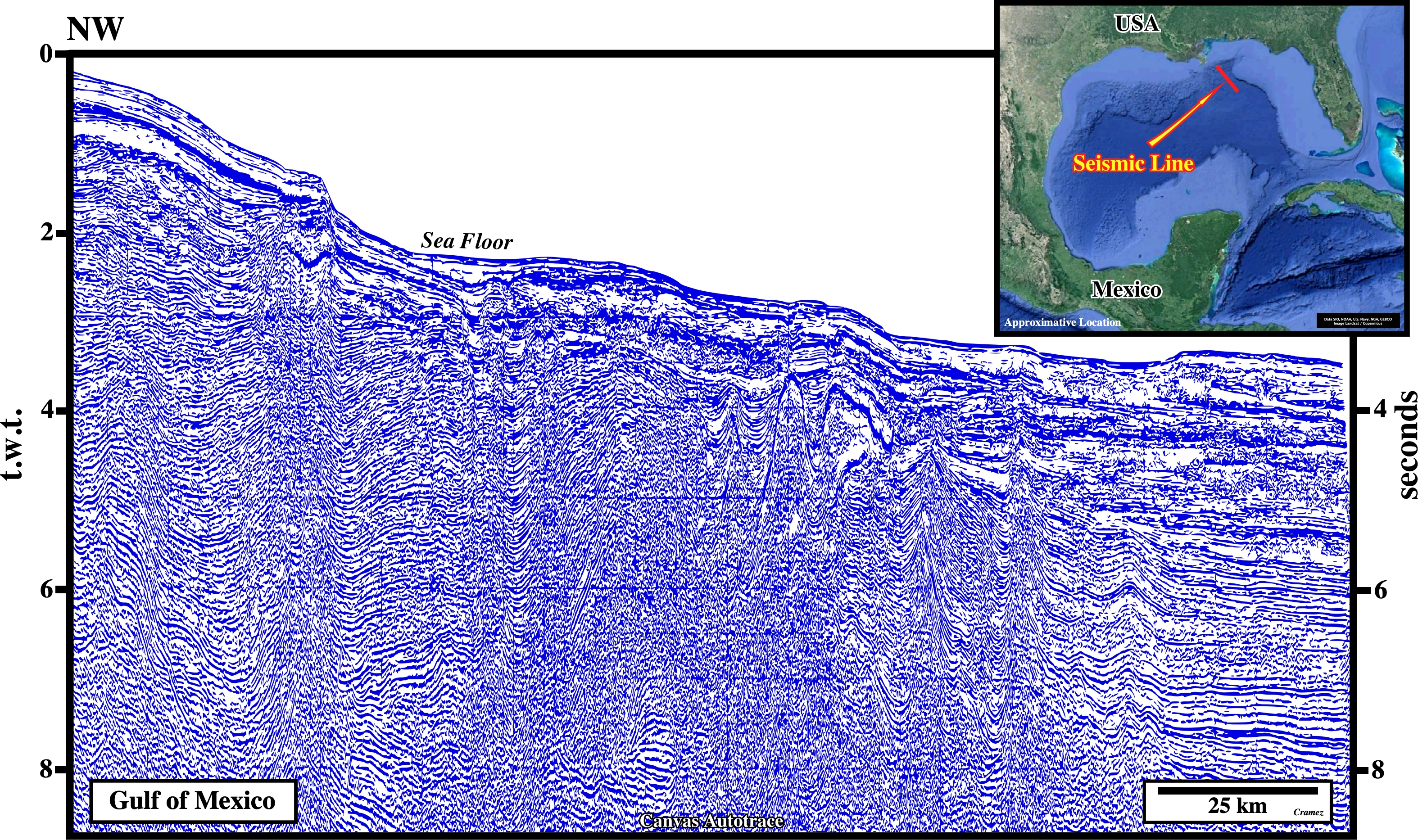
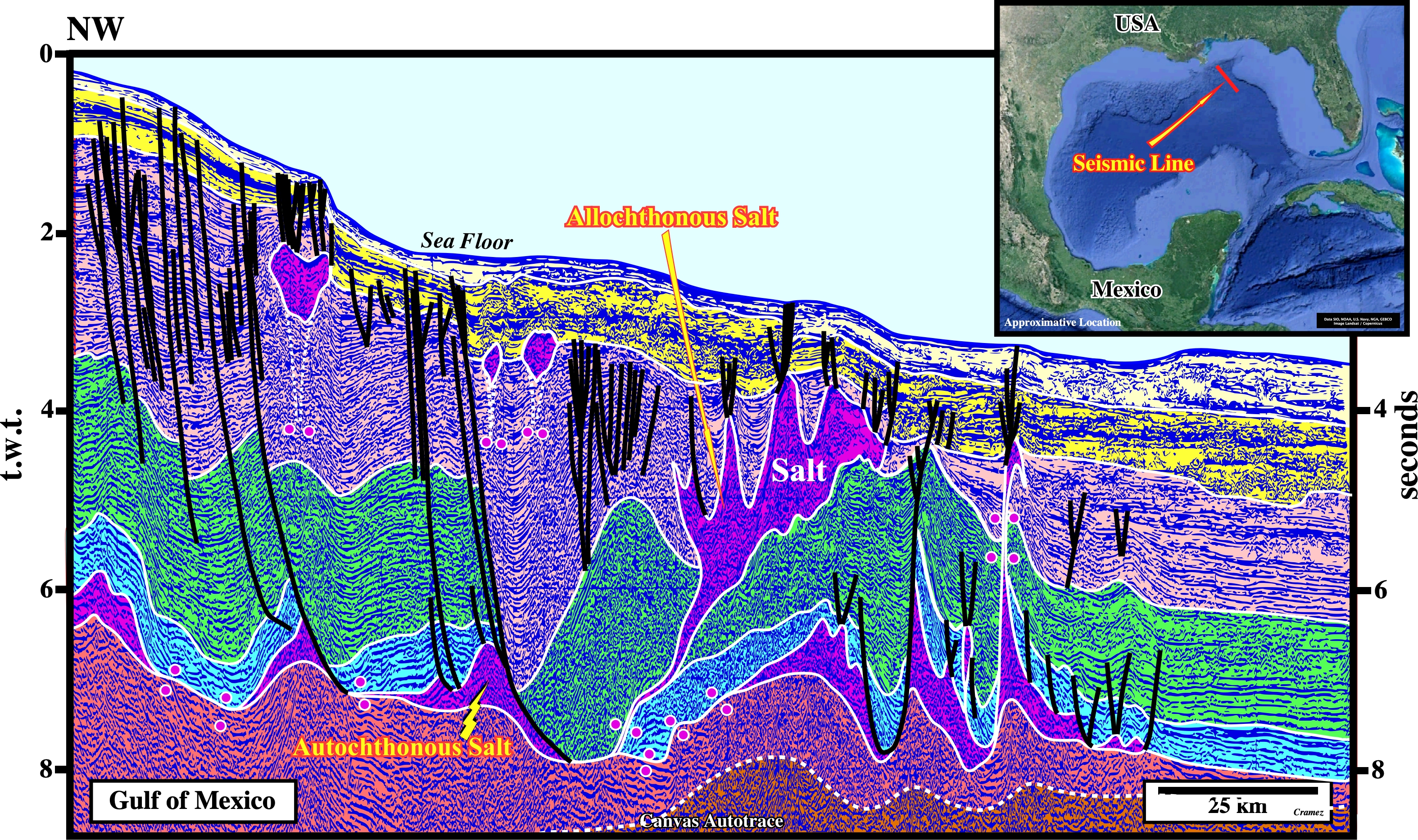
On this tentative geological interpretation, in association with the autochthonous salt layer, it is easy to recognize : (i) Rafts, i.e., fault blocks of allochthonous overburden that have separated to the extent that they no longer rest on their original foot-wall and lie, entirely, on a decollement layer, which typically consists of rock salt ; (ii) Salt Rollers, i.e., low-amplitude asymmetric salt structures comprising two flanks: a longer, gently dipping flank in conformable stratigraphic contact with the overburden and a shorter, more-steeply dipping flank in normal-faulted contact with the overburden ; (iii) Salt welds, i.e., surfaces or zones joining strata originally separated by autochthonous or allochthonous salt ; (iv) Primary Salt Welds joining strata originally separated, by gently dipping, autochthonous bedded salt ; (v) Secondary Salt Welds joining strata, originally, separated by steep-sided salt diapirs (salt walls or salt stocks) ; (vi) Tertiary salt welds joining strata originally separated by gently dipping allochthonous salt sheets ; (vii) Salt Ramps, i.e., feeders of allochthonous salt structures in which the salt thickness is higher than the seismic resolution, that is to say, the salt can be recognized on seismic lines ; (vii) Apparent downlap surfaces, which, often, correspond to tilted onlap surfaces induced by salt evacuation ; (vi) Mini-basins that are syn-kinematic basin subsiding into relatively thick allochthonous or autochthonous salt and that, often, are the expression of spoke circular or may reflect, merely, random patterns of differential loading.



Send E-mails to carlos.cramez@bluewin.ch with comments and suggestions to improve this atlas.
Copyright © 2001 CCramez
Last update:
2022