
East Canada Offshore
Baffin Island- West Greenland
East Canada Offshore
Baffin Island- West Greenland
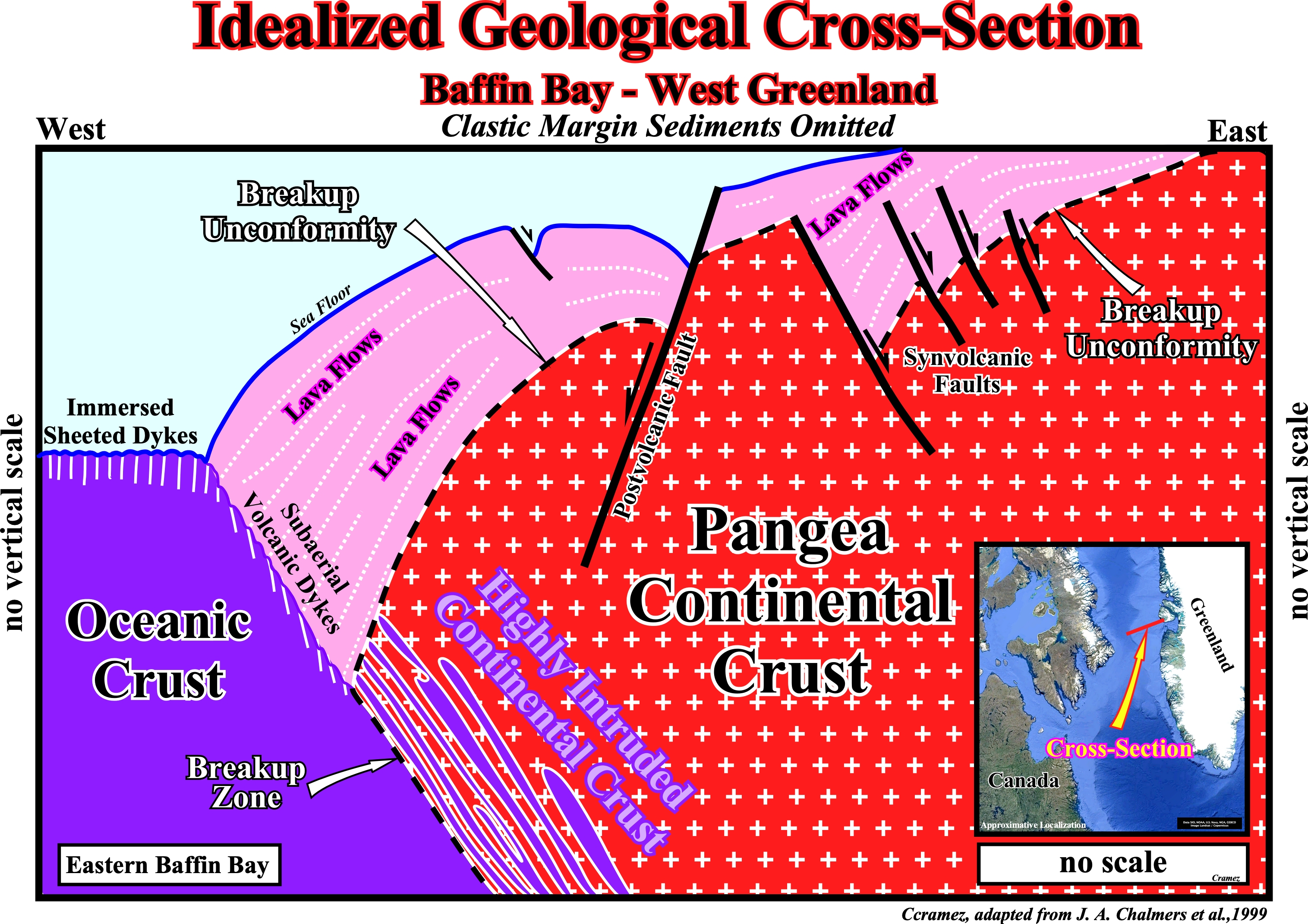
On this idealized geological cross-section between the the oceanic crust and the Pangea continental crust in the southern Baffin Bay, the breakdown of the continental crust is assumed to be the consequence of the injection of mantle material in a thinned and lengthened sector of the Pangea supercontinent. In fact, since the amount of injected volcanic material becomes predominant over the continental material two new lithospheric plates are individualized each side of the injected zone, which becomes a sub-aerial valley rifted (outcropping volcanic dykes) from which mantle material is effused outward forming lava flows (if the lava flows enters an aquatic environment, as a lake or shallow sea, it "fozen" forming delta lavas as illustrated on next autotrace). However, with time and due to the stacking weigh of the successive lava-flows, the initial sub-horizontal lava-flows become tilted toward breakup zone forming what the geoscientist called, on the seismic data (before knowing their lithology) seaward dipping reflectors (SDRs). Since the tilting is enough to plunge into the sea the expansion centers, the molten basaltic material rising from the mantle to the sea floor is quickly solidified (lava cannot floe under water) forming the oceanic crust. It is this transition between the oceanic crust (immersed sheeted dykes) and the lava-flows (sub-aerial lava flows) that this cross-section is supposed to depicted. Certain geoscientists explain the sub-aerial lava-flows and particularly the formation of the post-break half-grabens (not rift-type basins) as a consequence of a strong mantle activity (inward convection motion), which induces a lengthening of the crust (mainly of the upper brittle crust) by normal faults, generally, looking toward the continent, even after the breakup of the lithosphere, i.e., during and after the deposition of the SDRs. By contras,t they assume that in a non-volcanic continental margins, the absence of sub-aerial lava flows and a strong lengthening of the lithosphere over a detachment surface, the mantle seems to be is passive (outward convention motion).


The basaltic buried-hill illustrated on this Canvas autotrace can be interpreted as a sub-aerial expansion center with pouring out lava flowing in all direction forming lava deltas as it enter in aquatic environment (lake, shallow sea). Lava deltas, which look like river deltas, are formed wherever lava-flows, effused from an expansion or spreading center, enter a standing water-body. The lava cools and breaks apart in contact with the water and the resulting fragments are accumulated in situ (lava cannot flow under water).



Send E-mails to carlos.cramez@bluewin.ch with comments and suggestions to improve this atlas.
Copyright © 2001 CCramez
Last update:
2022