
West Iceland Offshore
Siglufjöröur Offshore
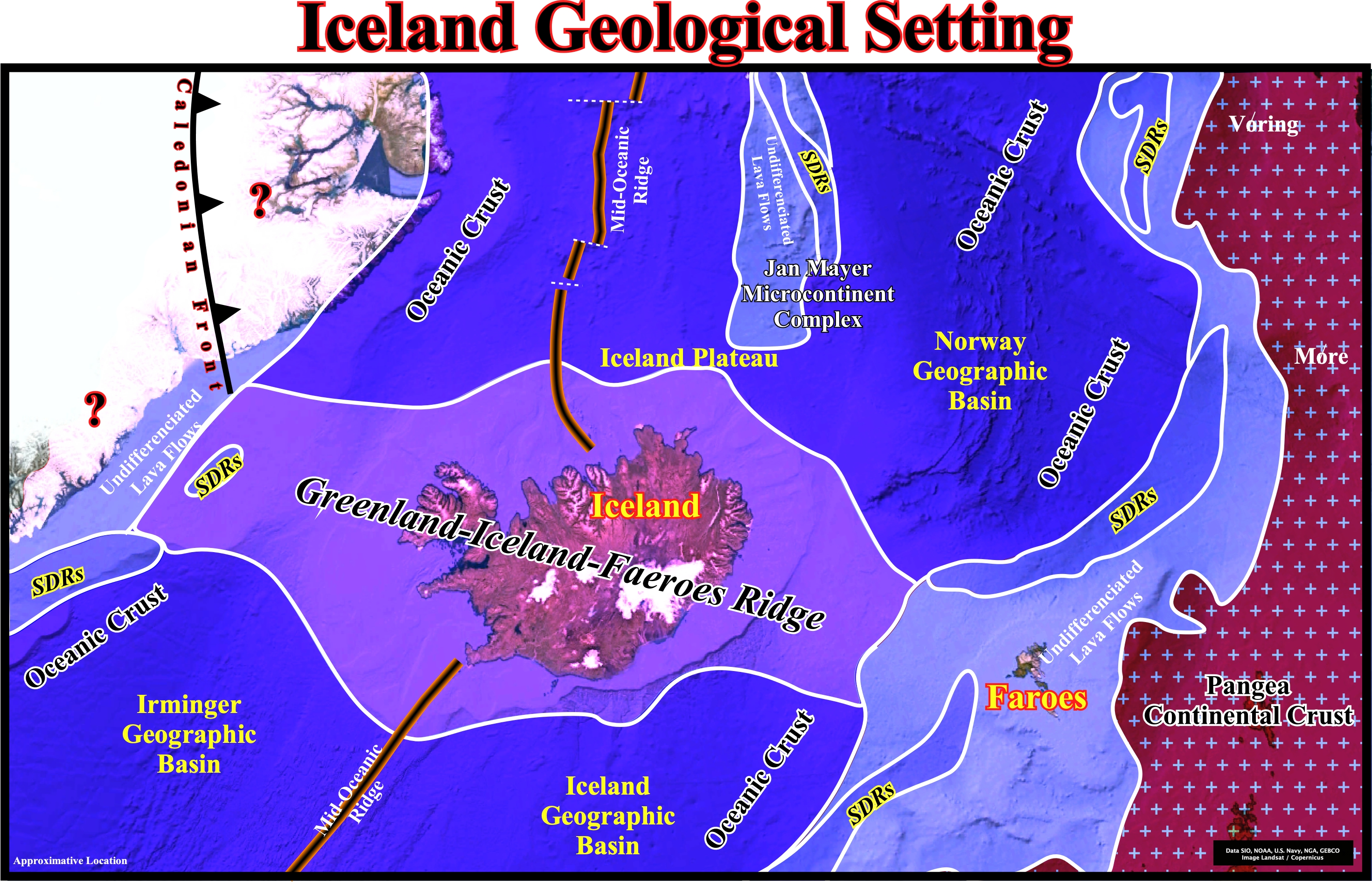
As illustrated on this schematic geological setting of Iceland, the predominant feature is the Greenland–Iceland–Faroe Ridge Complex (known, often, by the acronym GIFRC), which seems to exist since the Paleocene, i.e., since the opening of the NE Atlantic Ocean. In fact, the majority of the geoscientists think the Rockall valley-rift (Mesozoic breakup zone of the North Atlantic), shift westward to the Reykjanes valley rift (Mid-Oceanic ridge) at that time (see Page 12H). Along the GIFRC, several abandoned rift-type valleys by lateral jumps of the valley-axis and seamounts have been mapped (A. Hjartarson et al., 2017). The different rift-valleys corroborate crustal accretion data through time. The seamounts, particularly, southward of ridge complex, seem to be younger than the surrounding ocean floor, suggesting a still active intra-plate volcanic zone.

Theoretically, between the East Greenland Atlantic-type divergent margin and the Faroes platform, a schematic geological cross-section shows the outcropping oceanic crust, in the Iceland onshore and oceanic crust, to be, progressively, fossilized by sediments ranging from the Eocene to Recent, with some sub-aerial volcanic crust, i.e., lava-flows above the breakup unconformity that separates them from the Pangea continental crust. Certain geoscientists (Hjartarson, A. et al., 2017) could be able to individualize and date different oceanic expansion sectors as illustrated above.

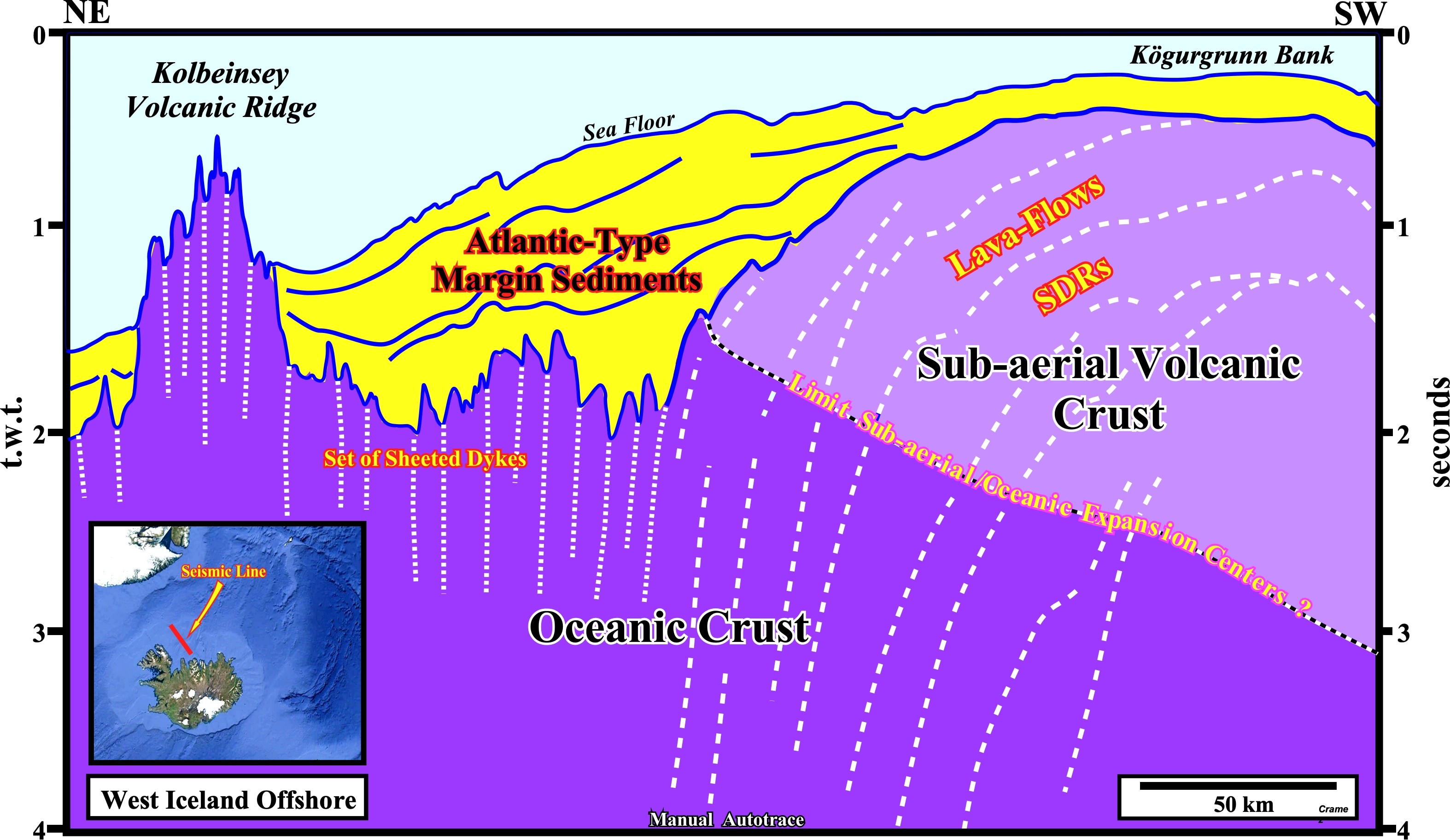
This manual autotrace highlights the asymmetric slow-spreading Kolbeisey volcanic ridge, which expansion is around 10mm/year, and the Kögurgrunn bank that seems to correspond to a stacking of lava flows effused from sub-aerial expansion centers (volcanoes or sheeted dykes). In fact, the Kolbeisey volcanic ridge is the seaward prolongation of the Late-Pleistocene /Holocene small Kolbeisey island that is the outcropping portion of the Mid-Atlantic Ridge. An eventual limit between the oceanic crust (set of sub-aerial vertical sheeted dykes) and sub-aerial volcanic crust (lava-flows, i.e., seaward dipping reflectors thinning continentward) is proposed at the hinge line of the associated reflectors. The depocenter of the Atlantic-type divergent margin sediments that fossilize the oceanic and sub-aerial crust seems to be directly related with the plunge or immersion of the spreading centers.



Send E-mails to carlos.cramez@bluewin.ch with comments and suggestions to improve this atlas.
Copyright © 2001 CCramez
Last update:
2022