.jpg)
Mozambique Offshore
Mozambique Geographic Basin

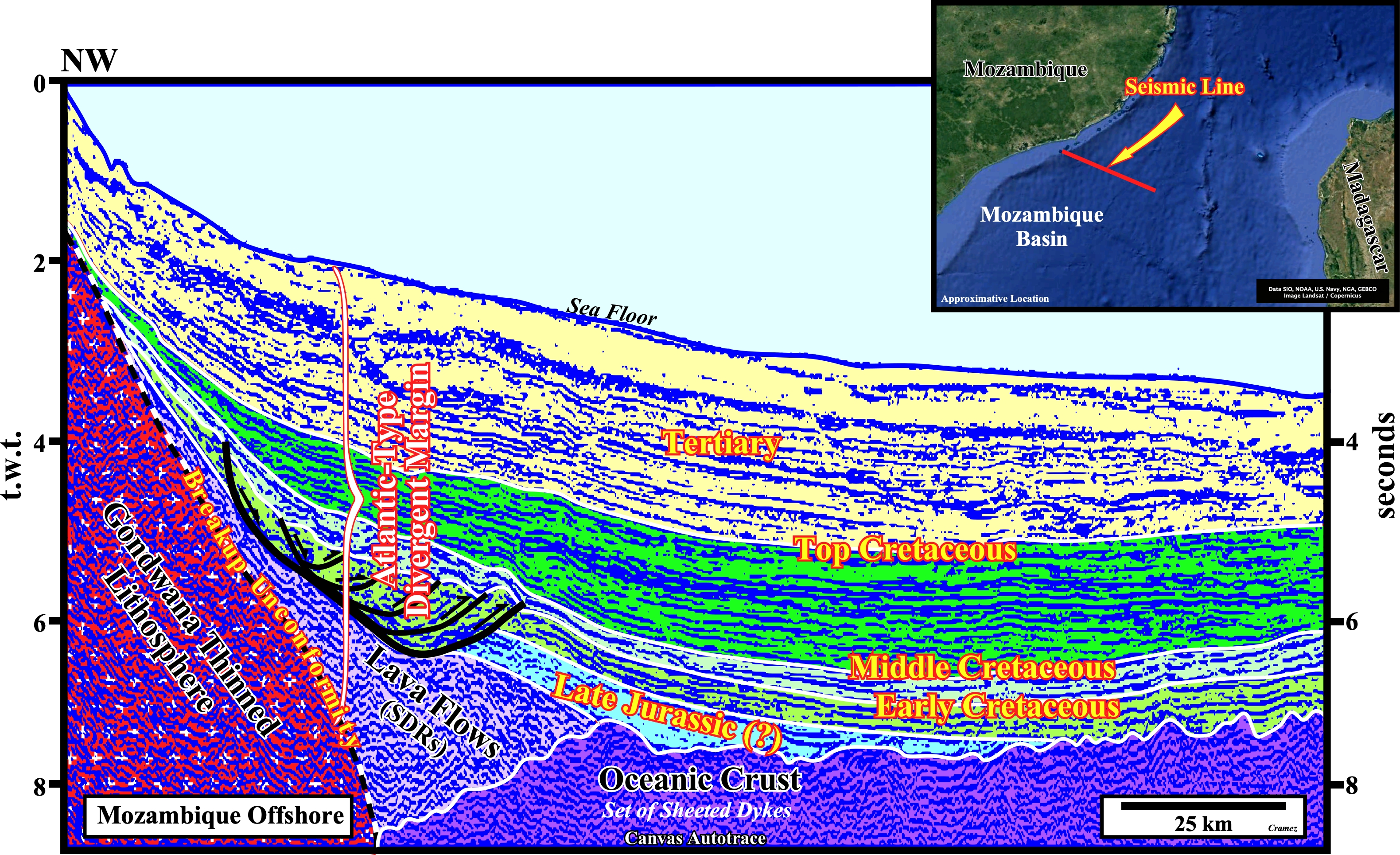
On this tentative interpretation of a Canvas autotrace of a Mozambique geographic basin seismic line, the breakup of the Gondwana thinned lithosphere, in which rift-type basins developed during its lengthening preceding the breakup, was completely tilted seaward due to the sinking of the lava-flows (SDRs) induced by the stacking overload. The lava-flows from the spreading centers (mantle material arriving at a sub-aerial environment) toward the continent (new lithospheric plate). However, since the spreading centers become submerged (due to the weigh of the stacking of the younger lava-flows) the mantle material arriving at the sea floor, via sheeted dykes, froze forming the oceanic crust, often, under the form of pillow lava. Above the breakup unconformity, the 2sd Phanerozoic continental encroachment stratigraphic cycle, i.e., the post-Pangea eustatic cycle (the Atlantic-type divergent margin, in which the lava-flows are included forming the volcanic sector of the margin) is deposited. It is interesting to notice that a set of listric faults, characterized by a "spoon" movement (normal geometry up-dip and reverse geometry down-dip) was developed during the Early-Middle Cretaceous probably in association with the seaward tilting of the basin.
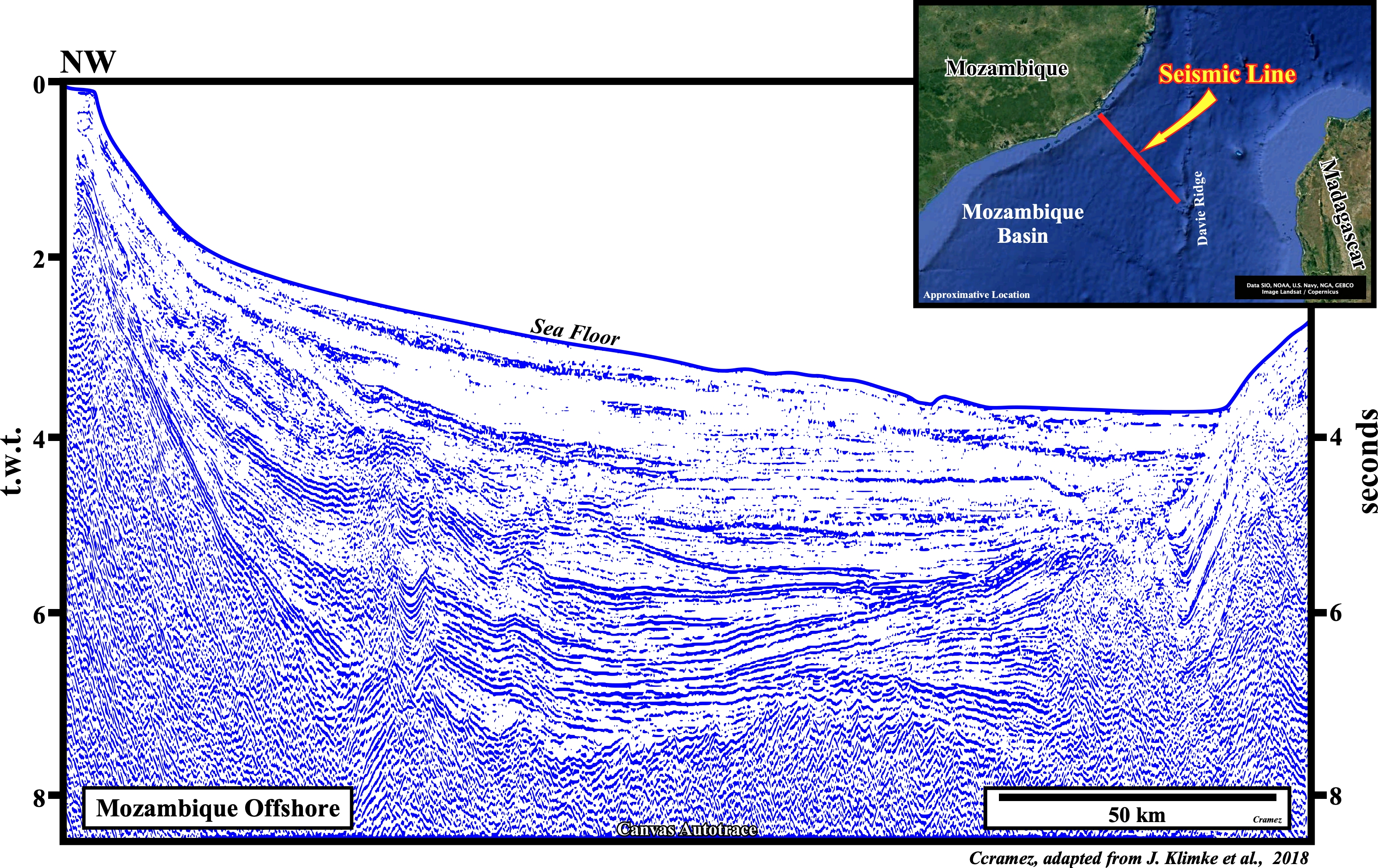
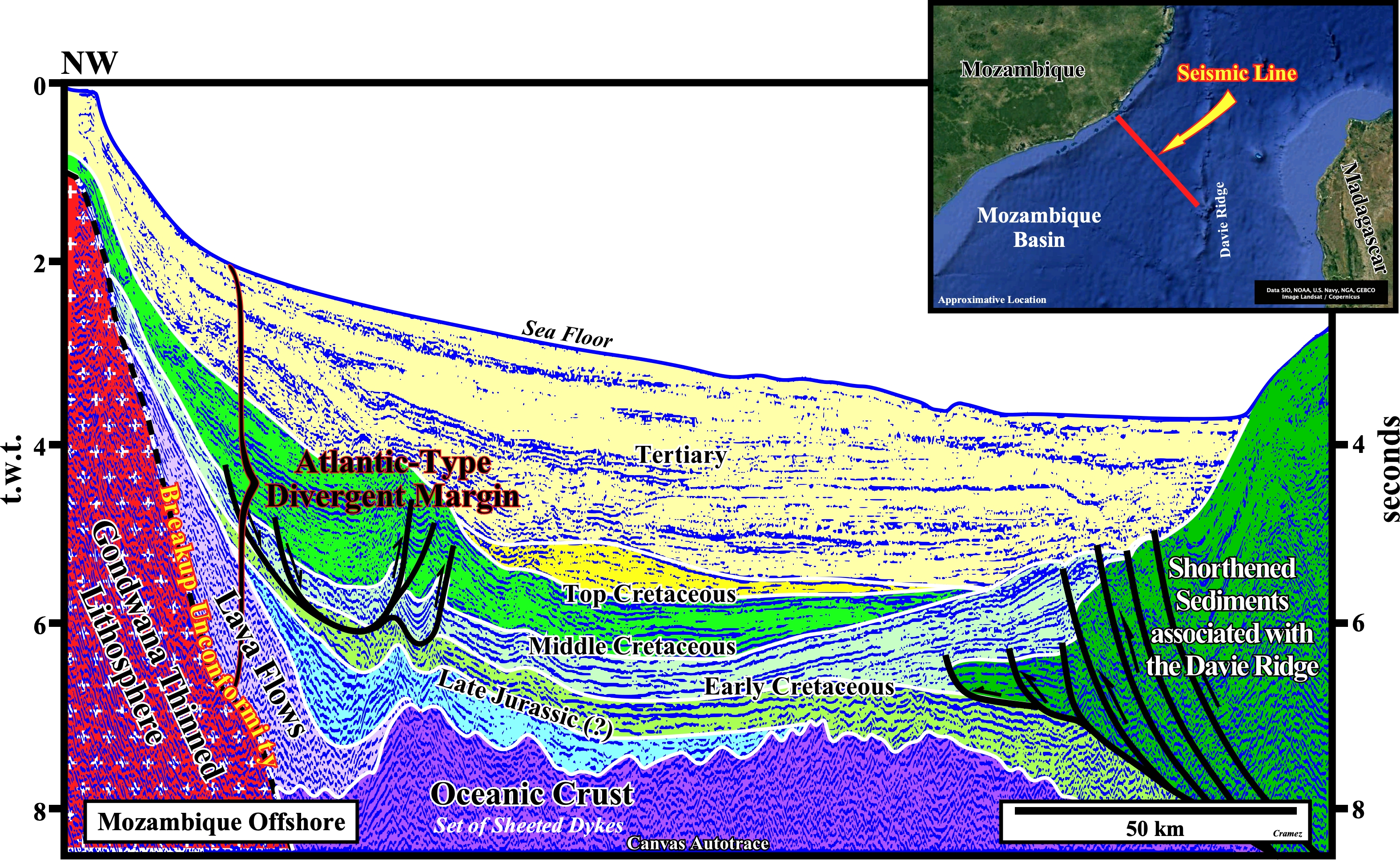
On this tentative geological interpretation of a Canvas autotrace of a seismic line shot not far from the line illustrated on the previous plates (Mozambique geographic basin), in addition to the recognized geological events, the west flank of the Davie ridge with its set of thrust faults a shortened sediments is quite well visible. As illustrated on Page 66 , a B-type subduction zone can be invoke to explain the shortening of the Cretaceous sediments forming the Davie ridge. In fact, the Mozambique and Morondava geographic basins are separated by the Davie Ridge and the Morondava geographic basin can be considered as a backarc basin


Send E-mails to carlos.cramez@bluewin.ch with comments and suggestions to improve this atlas.
Copyright © 2001 CCramez
Last update:
2022