.jpg)
Somalia Offshore
Mid Somalia High
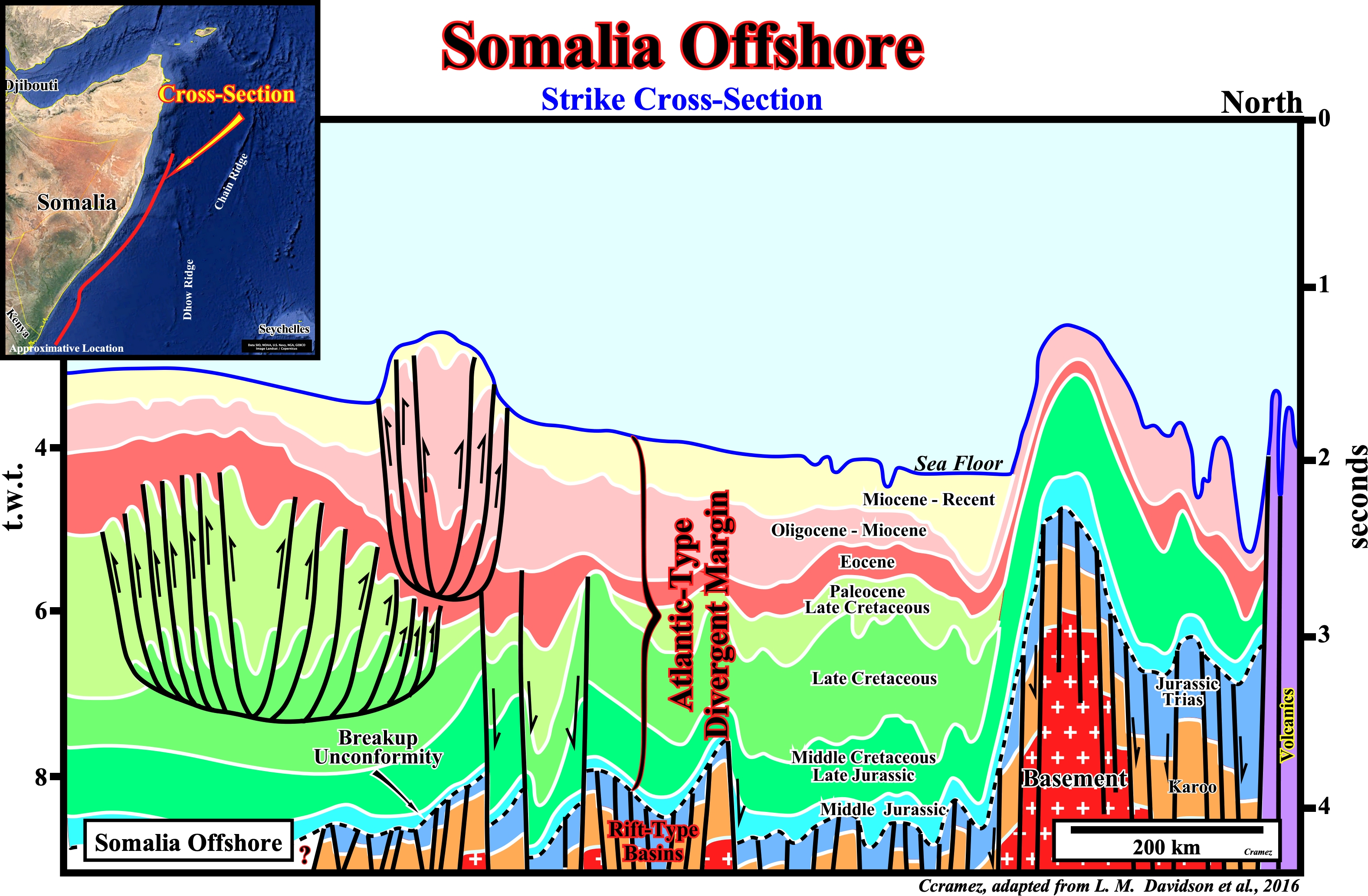
On this time geological cross-section of the Somalia offshore, based on a tentative geological interpretation of a composite strike seismic line, the breakup unconformity, which emphasizes the breakdown of the thinned Gondwana lithosphere, is quite well recognized by the abrupt change in the subsidence mechanism: differential subsidence during the formation of the rift-type basins, which age ranges from Permo-Trias to Early Jurassic and thermal subsidence while during the overlying divergent Atlantic-type margin. Two complex set of listric faults (gravity collapse up-dip and compressional folded belt down-dip) at different levels are also, easily, recognized on the southern part of the cross-section. The lower level folded belt is know as Kismaayo folded-belt and the upper one as Baraawe folded-belt (see also Page 41 of Kenya offshore). A basement structural high is, also, easily recognized in the northern part of the cross-section and illustrated on the next manual autotrace. . These geological features allow geoscientists two subdivide this offshore int three sectors: (i) Southern (Jubba Deep) ; (ii) Middle (Mogadishu Deep) and (iii) Northern (Middle Somalia high). A rifted controlled Karoo (non-marine sediments mainly shales, red beds, silt-stones and great quantities of volcanics, appearing to record a gradual climatic shift toward ever-increasing aridity (www.britannica.com/ place/Karoo-System) and Early Jurassic rift-type developed during the rifting (lengthening) of the Gondwana small supercontinent seem to begin in Late Carboniferous and continued until Early Jurassic. The breakup of the Gondwana lithosphere induced the separation of East Antarctica from East India and a coeval development of an oblique rift valley between Somalia and the Madagascar- Seychelles-India.
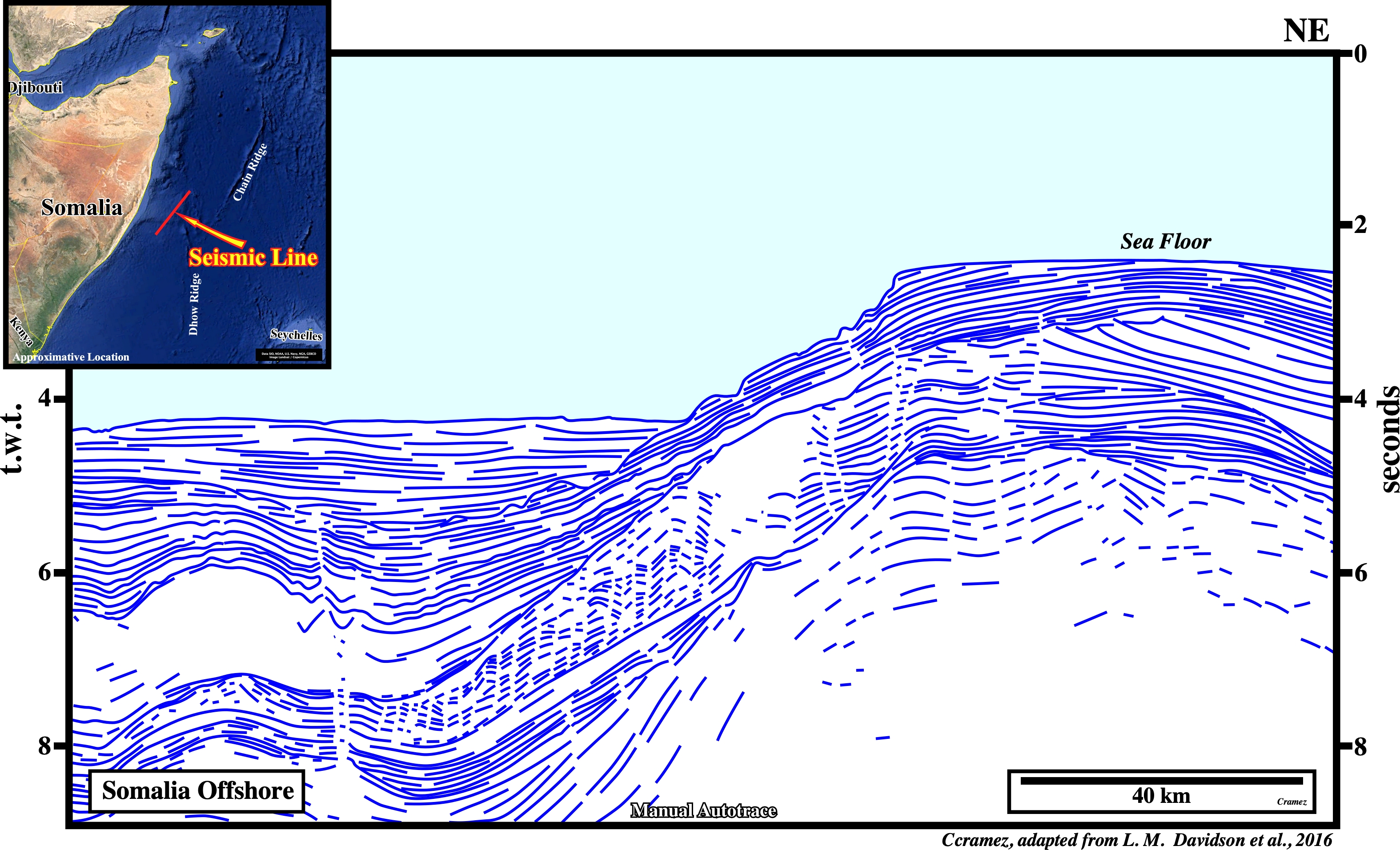
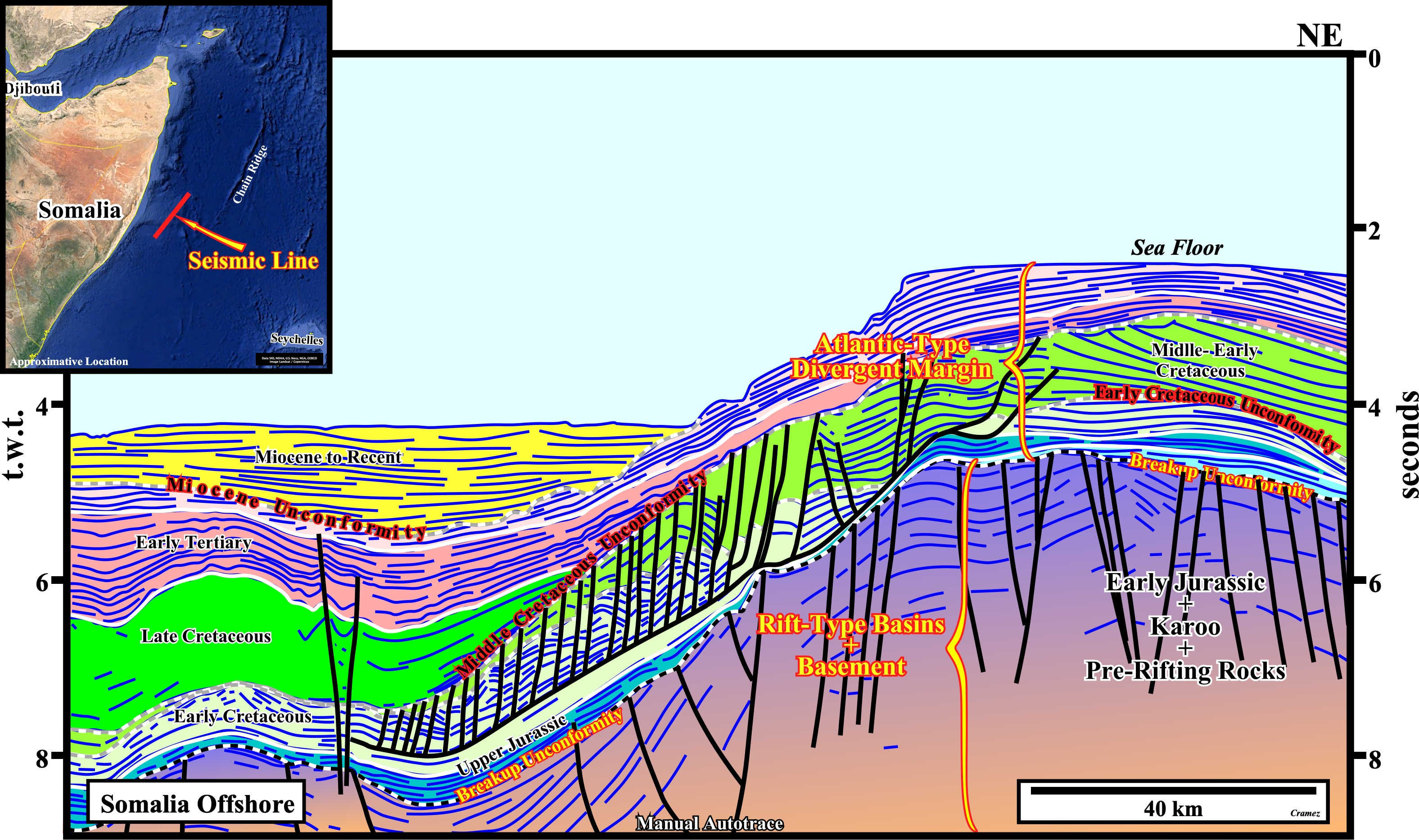
This manual autotrace of a North-South seismic line of the Somalia offshore illustrates the middle Somalia high. This structural high seems to correspond to a compressional uplift (there are extensional sedimentary uplifts induce by halokinesis and shalokinesis) associated with a compressional tectonic regime that took place, mainly, during the Middle-Early Cretaceous. Such uplift created a significant relative sea level fall (do not confuse with an absolute or eustatic sea level fall) that originate the Middle Cretaceous unconformity, which fossilized, totally, during the Early Miocene. During the tectonic uplift the Early Cretaceous sediments were, highly, lengthened, particularly, on the southern as illustrated on this tentative geological interpretation, in which the rift-type basins, rift controlled Karoo sediments and the basement rocks are group in a single rock package.


Send E-mails to carlos.cramez@bluewin.ch with comments and suggestions to improve this atlas.
Copyright © 2001 CCramez
Last update:
2022