
Venezuela Offshore
Vela Geographic Basin
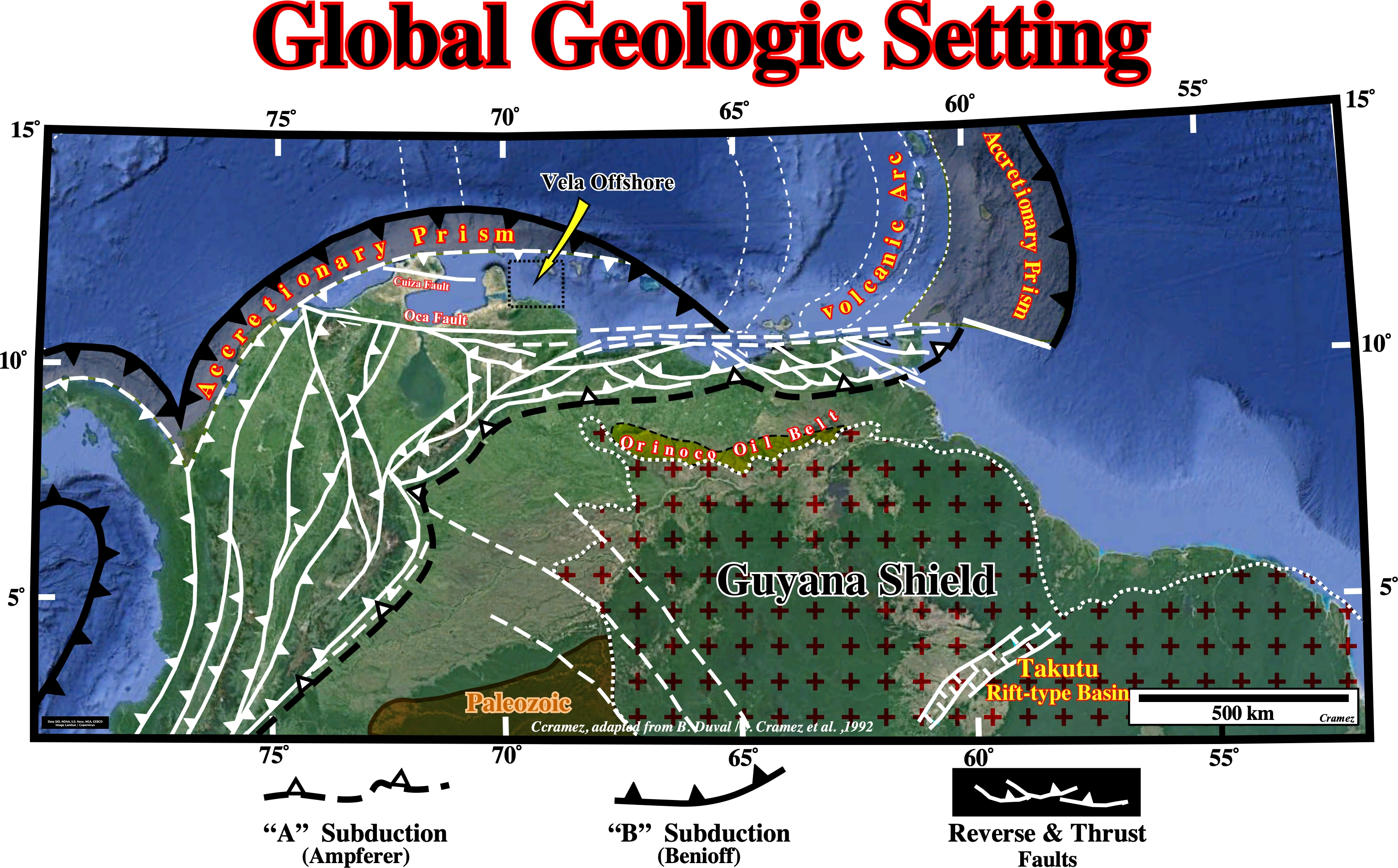
This tectonic sketch is a tentative representation of the global geological setting of the South America lithospheric plate, in which two main subduction zones are clearly visible, which bound the Meso-Cenozoic megasuture. The northern subduction zone is a B-Type subduction (Benioff type), in which the descending plate is oceanic. B-type subductions are highlighted by an: (i) Oceanic trench ; (ii) Alignment of volcanoes and (iii) Deformation in the overriding plate, which often causes the formation of mountains. The southern subduction zone is A-type subduction zone (Ampferer type), in which the descending plate is continental. A-type subduction are characterized by a foreland basin (foredeep). The area of interest (Cariaco /Margarita Platform), located westward of Trinidad, lies within the Meso-Cenozoic megasuture. It is highly shortened, as depicted on the N-S geological cross-section illustrated on the next plate. The presence of W-E strike-slip faults, as El Polar fault, creates, mainly, two types of sedimentary basins : (i) "Great Basin" Type and (ii) California-Type. The "Great Basin"-Type Basins are dominated by a complex tectonics linked to a pair of mega-shears where tilted blocks individualize a large number of small basins (e.g., Vela geographic basin in North Venezuela Offshore). This tilting geometry contrasts with that of Californian-type basins which are most often uniform and very flat. The substratum of basins of the "Great Basin" type consists of folded belts with their procession of folds, thrusts and granite remobilizations. Californian-type basins are generally filled with marine sedimentary sequences, most often of great water depth. Basins of the "Great Basins" type are, rather, filled with predominantly continental or shallow water sediments. From the tectonic point of view, Californian-type basins are dominated by compressive structures (folds, reverse faults and thrusts), while the deformations linked to "Great Basin" -type basins are rather deformations in extension (tilted blocks).
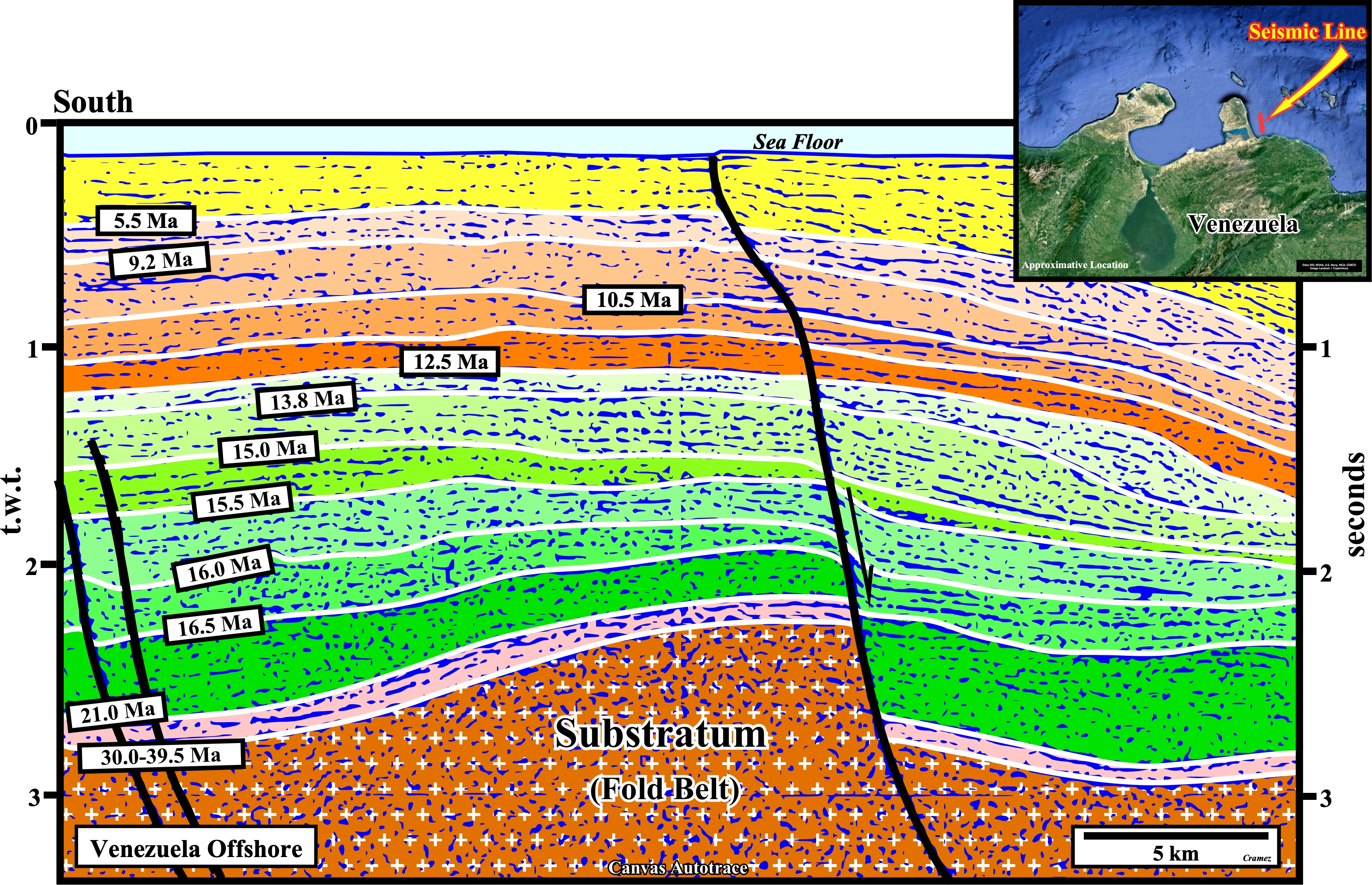
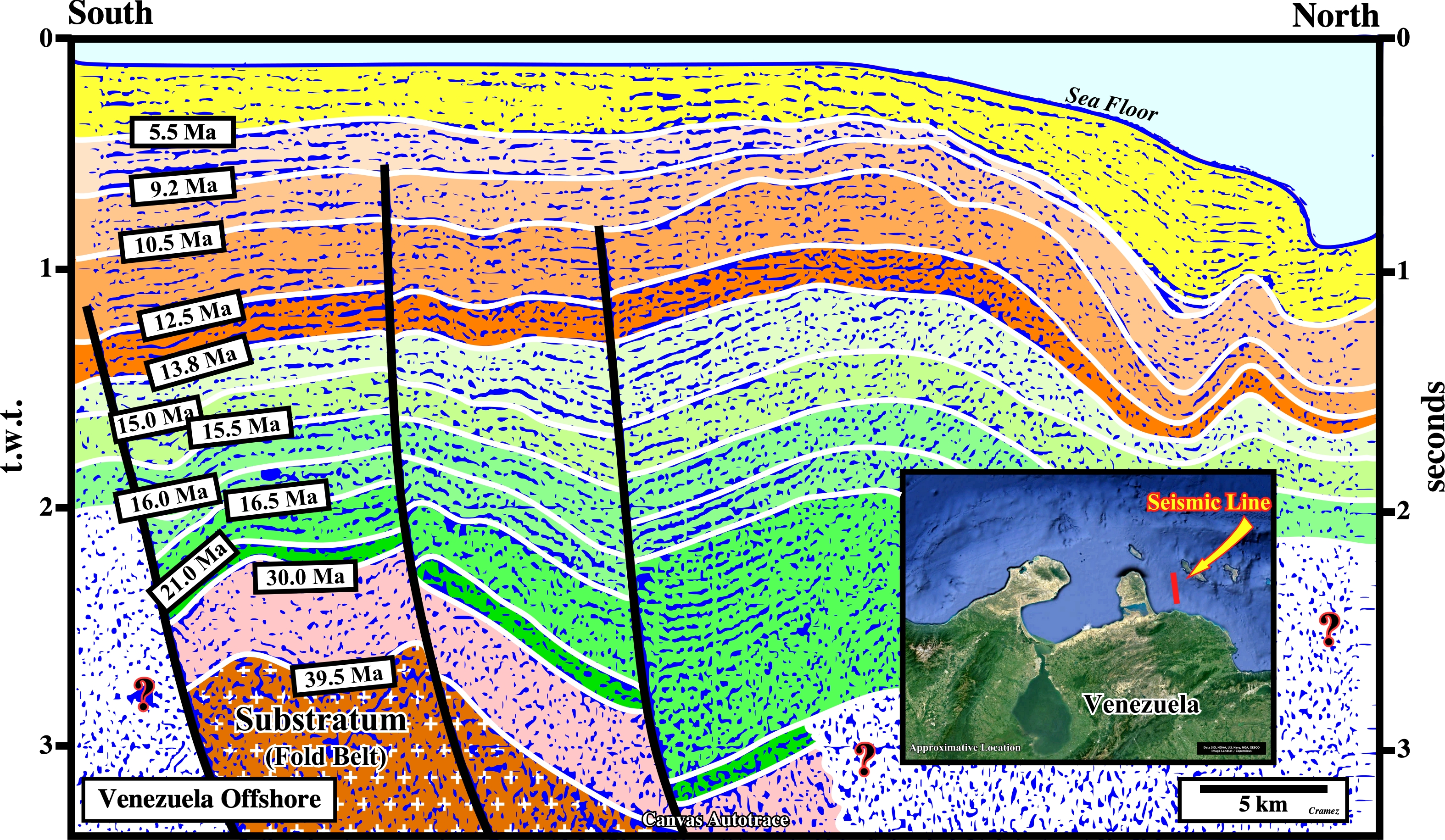
These tentative geological interpretations of two seismic lines of the Vela geographic basin offshore are typical of episutural sedimentary basin and particularly, of the "Great Basin"- type. In fact, firstly, they are closely related to the formation of Meso-Cenozoic megasuture and they are inside of it. Secondly, they are composed, mainly, of sediments associated with mega-shears, which develop numerous small tilted sedimentary basins in which, bulges, shears and normal faults can be developed. The tilting geometry, easily, recognized on these tentative interpretations contrasts with the of Californian-type basins which are, most often, uniform and very flat. Actually, the main differences between Californian (see Page 22 and Page 14D) and "Great basins" type basins are: (i) Californian-type basins develop on ancient accretionary wedges, fore-arc basins or eruptive massifs ; (ii) The substratum of basins of the "Great Basin"-type consists of fold belts with their procession of folds, thrusts and granite remobilizations ; (iii) Californian-type basins are, generally, filled with marine sedimentary sequences, most often of great water depth, while basins of the "Great Basin"-type are, rather, filled with predominantly continental or shallow water sediments ; (iv) From the tectonic point of view, Californian-type basins are dominated by compressive structures (folds, thrusts), while the deformations linked to "Great Basin"-type basins are rather deformations in extension (tilted blocks).



Send E-mails to carlos.cramez@bluewin.ch with comments and suggestions to improve this atlas.
Copyright © 2001 CCramez
Last update:
2022