.jpg)
Somalia Offshore
Juba Deep Geographic Basin
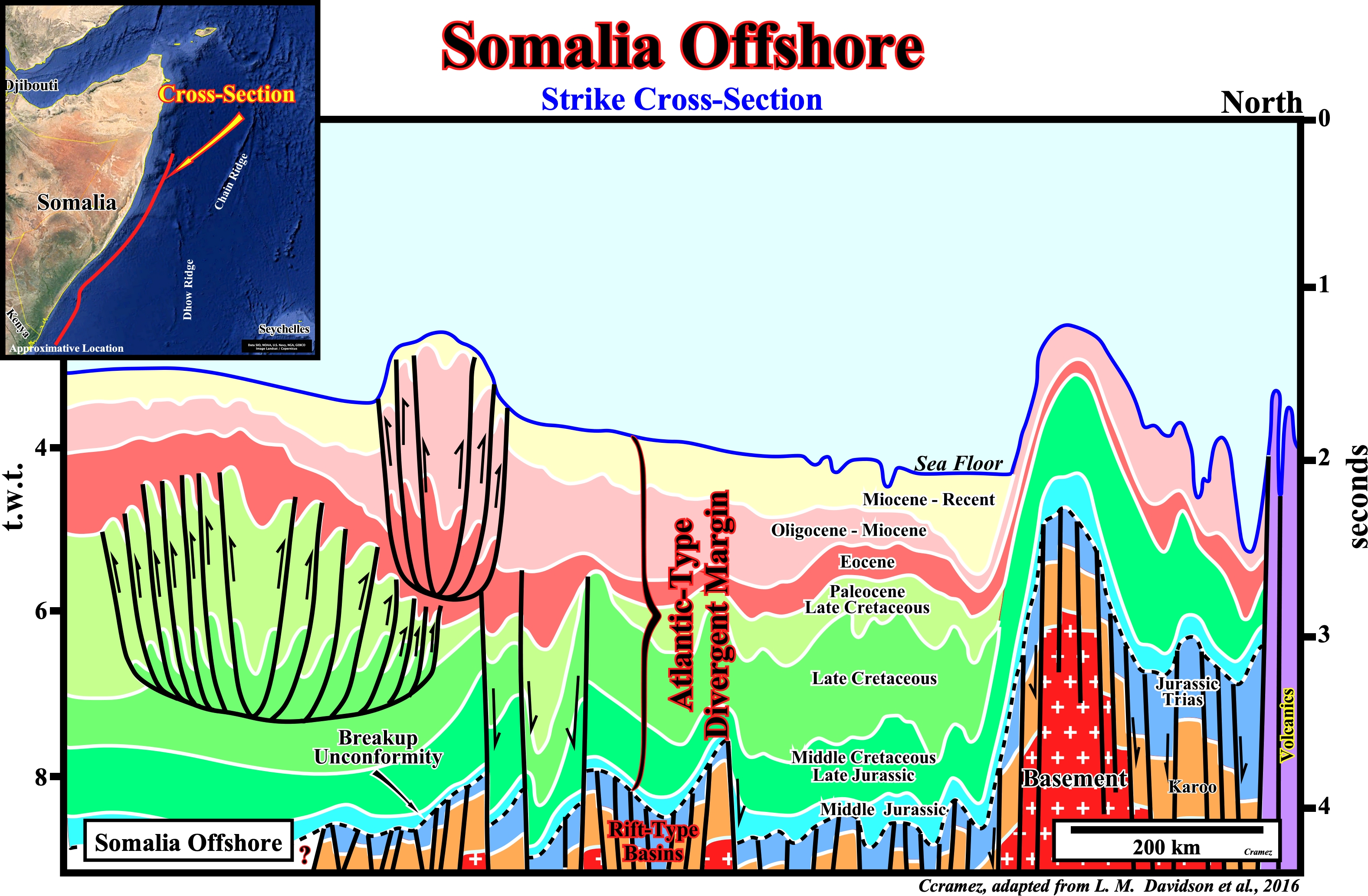
On this time geological cross-section of the Somalia offshore, based on a tentative geological interpretation of a composite strike seismic line, the breakup unconformity, which emphasizes the breakdown of the thinned Gondwana lithosphere, is recognized, quite well, by the abrupt change in the subsidence mechanism: differential subsidence, during the formation of the rift-type basins, which age ranges from Permo-Trias to Early Jurassic and thermal subsidence, during the overlying Atlantic -type divergent margin. Two complex set of listric faults (gravity collapse up-dip and local compressional folded belt down-dip) at different levels are also, easily, recognized on the southern part of the cross-section. The lower level folded belt is know as Kismaayo folded-belt and the upper one as Baraawe folded-belt (see also Page 41 of Kenya offshore). A basement structural high is, also recognized easily, in the northern part of the cross-section. These geological features allow geoscientists two subdivide this offshore int three sectors: (i) Jubba Deep in southern part ; (ii) Middle Mogadishu Deep in the central part and (iii) Middle Somalia high in the northern area. A rifted controlled Karoo (non-marine sediments mainly shales, red beds, silt-stones and great quantities of volcanics, appearing to record a gradual climatic shift toward ever-increasing aridity (www.britannica.com/place/Karoo-System) and Early Jurassic rift-type basins developed during the rifting (lengthening) of the Gondwana small supercontinent that seem to begin in Late Carboniferous and continued until Early Jurassic. The breakup of the Gondwana lithosphere induced the separation of East Antarctica from East India and a coeval development of an oblique rift valley between Somalia and the Madagascar- Seychelles-India, which western sector is illustrated by the next Canvas autotrace.
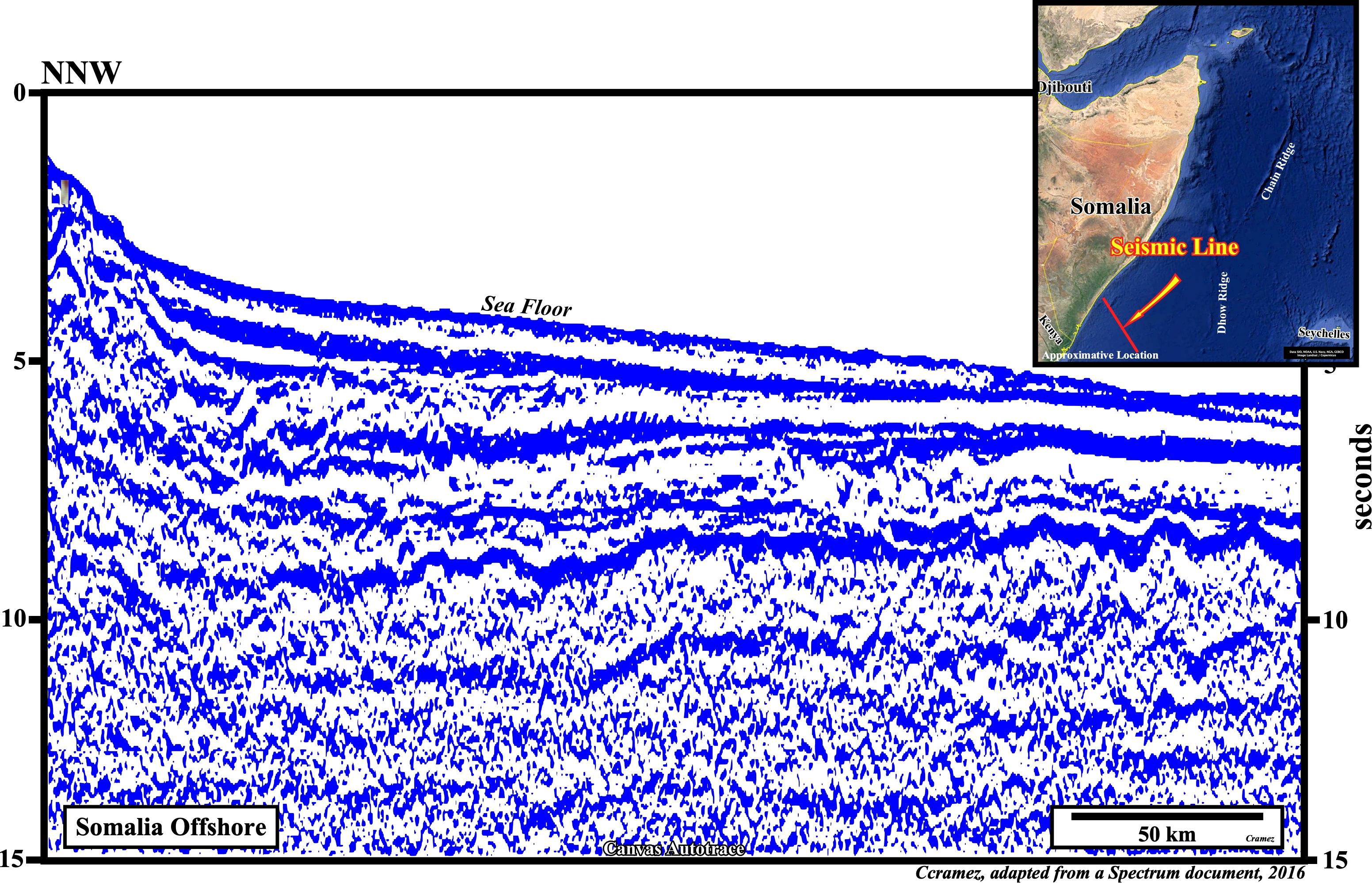
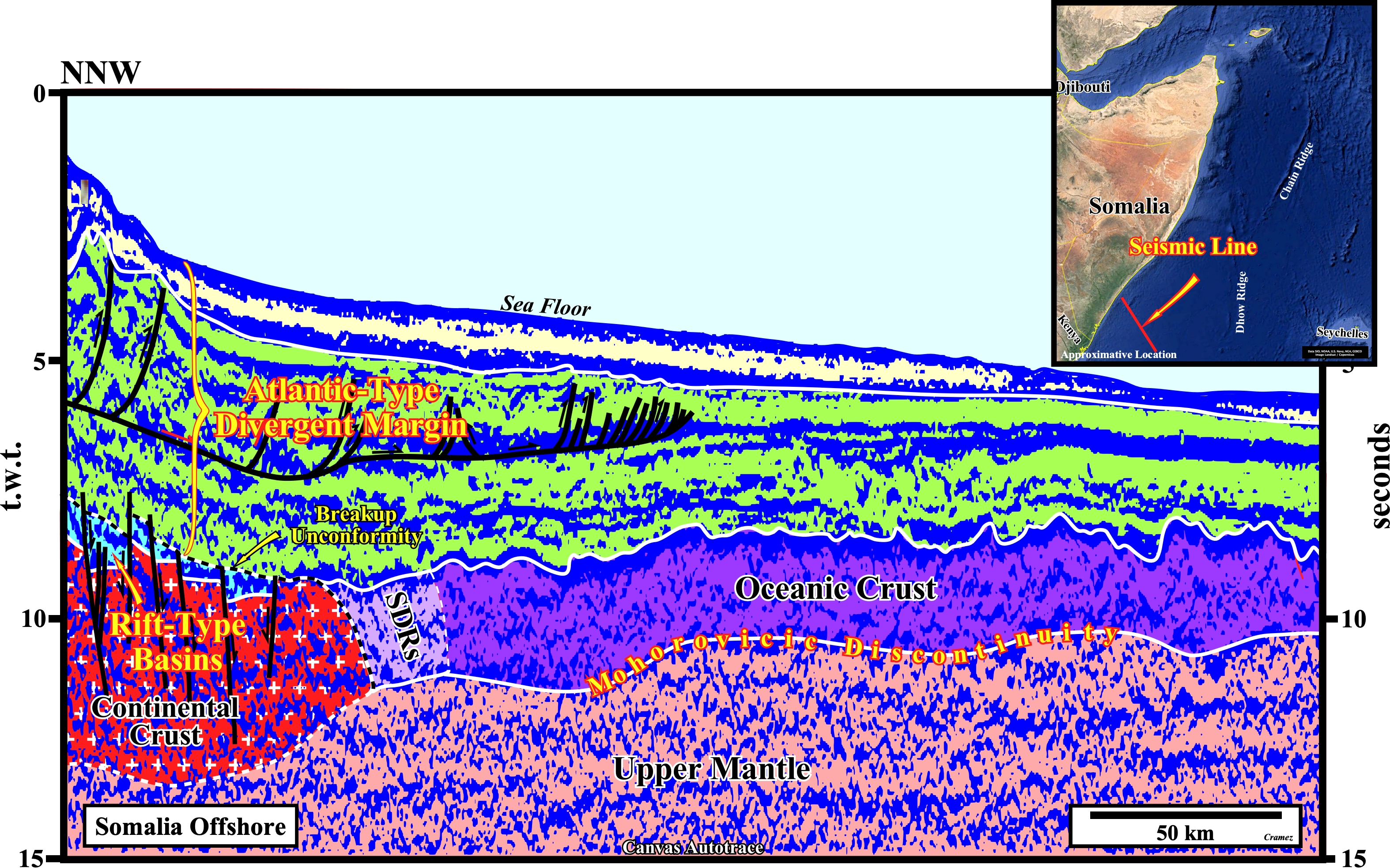
On this Canvas auto trace of a regional seismic line of the southern Somalia offshore, above the Upper Mantle, which is bounded by the Mohorovicic discontinuity of the lithosphere),usually referred as Moho) that marks a significant change in velocity of seismic waves induced by the different lithologies. In fact of the lithosphere) comprises continental crust, on which rift-type basins were developed, an Atlantic-type divergent margin with a volcanic sector (SDRs) and oceanic crust. As illustrated on this tentative geological interpretation, presently, the Earth's crust is formed by: (i) The old continental crust on which rift-type basins were formed, during the lengthening that predated breakdown of the Gondwana ; (ii) A sub-aerial volcanic crust or SDRs, i.e., post-breakup lava-flows, which accrete the continental crust meanwhile the expansion centers are not yet immersed and (iii) The oceanic crust, which is formed since the spreading or expansion centers become immerse due the overload of the successive lava-flows. Above the volcanic crust (SDRs and oceanic crust) and new continental crust (old continental crust + rift-type sediments) an Atlantic type divergent margin was deposited in association with the second 1st order eustatic cycle of the Phanerozoic, i.e., the post-Pangea 1st order eustatic cycle. In this Atlantic-type divergent margin (developed in an extensional global tectonic context, that is to say, outside of the Ceno-Mesozoic megasuture), an huge gravitational folded-belt was formed, which is better illustrated on the following manual autotrace.
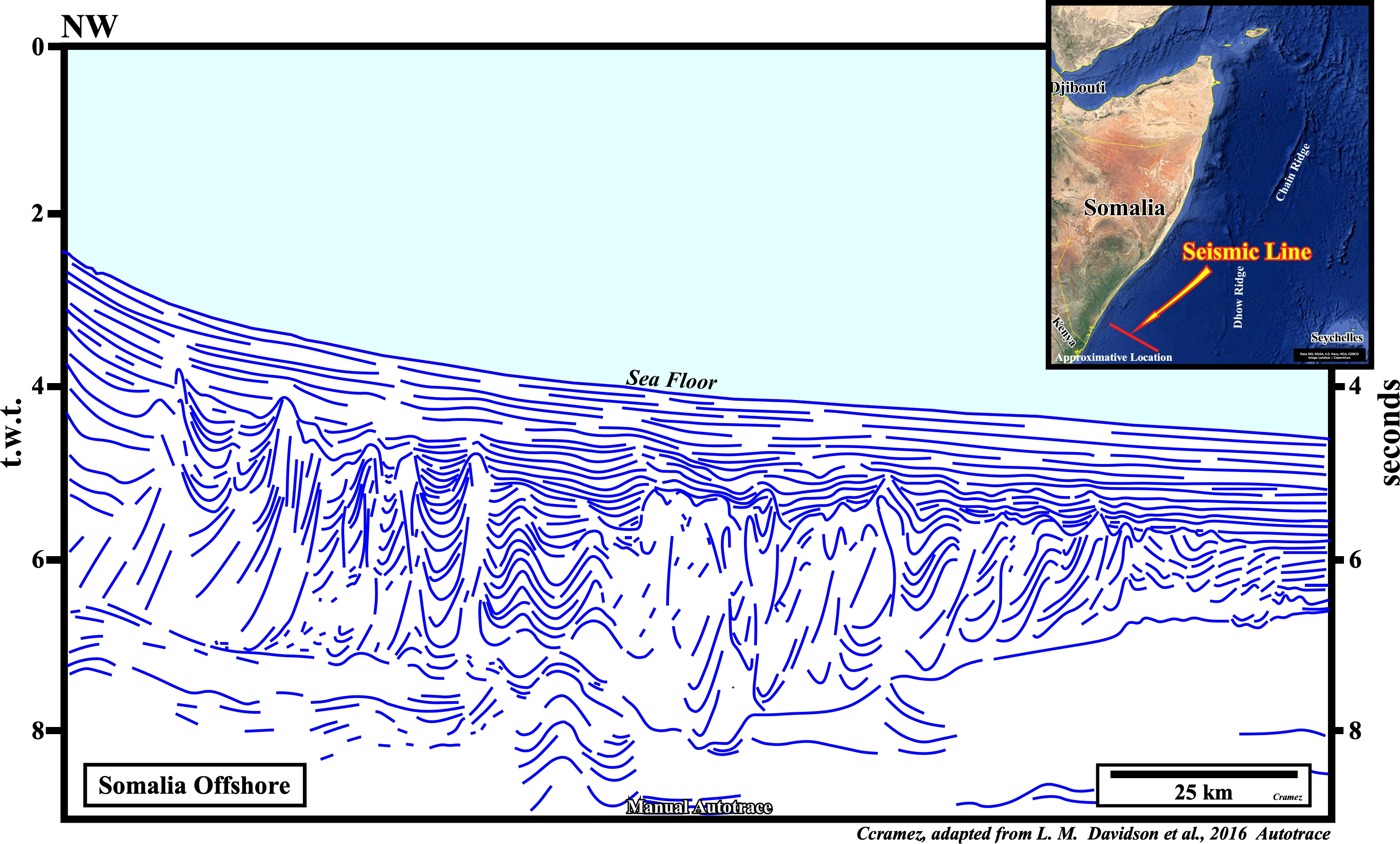

On this tentative geological interpreation, the Kismaayo gravitational folded-belt is quite well illustrated. The up-dip extension (lengthening) induced by the growth faults is balanced by its down-dip compressional (shortening) counterpart, i.e., by the thrust faults with an associated late shalokinesis (shale domes with small norml faults, under seismic resolution, which create, locally, an extensional tectonic regime, since the aybove sediments are lengthened and not shortened). The basement seems to be visible ont lower right corner of the autotrace. The seismic line of this manual autotrace beeing located in the southern part of the Jubba Deep sector, obvious the upper gravitation folded-belt (Baraawe folded-belt ) is not visible. The breakup unconformity is, probably, near the top Jurassic, where the normal fault responsible by the rifting are no more active. However, locally, certain rifting faults are reactivated during the Middle and Upper Cretaceous as illustrated on the Canvas autotrace of Page 68.
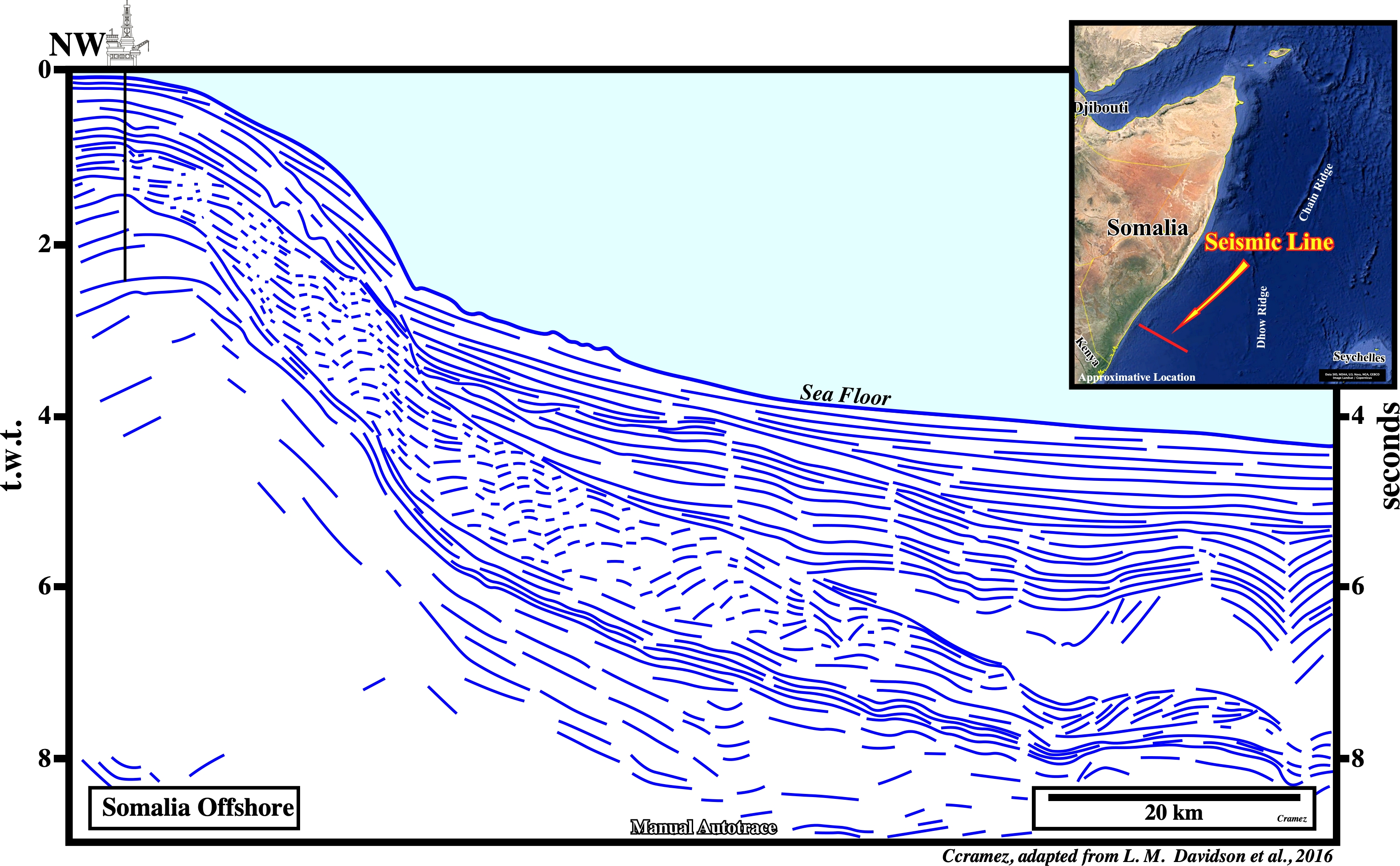

This tentative geological interpretation is calibrated by the results of an exploration well drilled on a structural high of the basement, which taking into account the internal configuration of the seismic reflectors corresponds, probably, to rifted controlled Karoo sediments and pre-rifting sediments. This structural high is, probably, associated with a tectonic inversion that can trigger off the listric faults along which a distal down-dip sedimentary shortening (folded-belt) countervail an up-dip extension (gravitational collapse of the divergent margin). Such a conjecture is corroborated by the reverse reactivation of the old normal faults bordering the rift-type basins observed in certain Canvas autotraces of this offshore (see Page 68). By the same token, the seaward dip of proximal sector of the detachment plane (taking into account the pitfall created by the abrupt changing of the water depth) associated with these listric fault seems to high to exclude a tectonic sedimentary uplift.


Send E-mails to carlos.cramez@bluewin.ch with comments and suggestions to improve this atlas.
Copyright © 2001 CCramez
Last update:
2022